Google Inc. is hiring. The company plans to hire over 6,000 new employees this year. From NPR:
The company outlined its hiring plans Tuesday with The Associated Press without providing many specifics beyond its pledge to hire more people than it did in 2007 when it added 6,131 workers. Google hired nearly 4,600 people last year to end 2010 with 24,400 employees. Based on its hiring commitment, Google's work force will increase by at least 25 percent this year.
Wow! A big company, doing so well that they want to hire thousands of new employees! This is great news, right?
Uh...not so much....
But Google's push to further expand a work force that grew by 23 percent last year may not be as well received on Wall Street, where the Internet search leader's spending has annoyed some investors who would prefer a more frugal approach in hopes of fatter returns.
Wall St believes that as long as the rising tide lifts the luxury liner, the rest of the boats can founder.
cross-posted at MainSt/workingamerica.org
Monday, January 31, 2011


Thursday, January 27, 2011
Jobless Claims Rose Last Week
From Bloomberg:
and
In the state of the union address, President Obama said that extending the tax cuts would create more jobs to add to the million jobs created by the private sector last year. I've pointed out that math isn't my strong suit in the past, but one million jobs is barely a drop in the bucket, when one thinks about either the official unemployment number of 9.4 percent or the real one, which is closer to 20% of the country being out of work.
Still, this kind of unemployment is never presented as any sort of an urgent crisis, despite the fact that it's affecting local, state, and federal revenue. This is the language of obfuscation:
It's disappointing that we seem to be wedded to policies that aren't working.
cross-posted at MainSt/workingamerica.org
Applications for jobless benefits increased by 51,000 to 454,000 in the week ended Jan. 22, Labor Department figures showed today. Economists forecast 405,000 claims, according to the median estimate in a Bloomberg News survey. The number of people on unemployment benefit rolls rose, while those collecting extended payments fell.
and
The number of people continuing to collect jobless benefits increased by 94,000 in the week ended Jan. 15 to 3.99 million. Economists forecast the number would increase to 3.87 million.
The continuing claims figure does not include the number of workers receiving extended benefits under federal programs.
In the state of the union address, President Obama said that extending the tax cuts would create more jobs to add to the million jobs created by the private sector last year. I've pointed out that math isn't my strong suit in the past, but one million jobs is barely a drop in the bucket, when one thinks about either the official unemployment number of 9.4 percent or the real one, which is closer to 20% of the country being out of work.
Still, this kind of unemployment is never presented as any sort of an urgent crisis, despite the fact that it's affecting local, state, and federal revenue. This is the language of obfuscation:
Economic expansion in the U.S. is “continuing, though at a rate that has been insufficient to bring about a significant improvement in labor market conditions,” the Federal Open Market Committee said yesterday in its statement after a two-day meeting in Washington.
Unemployment is too high to be consistent in the long run with policy makers’ congressional mandate of full employment, the Fed said, repeating that progress toward its objectives has been “disappointingly slow.”
It's disappointing that we seem to be wedded to policies that aren't working.
cross-posted at MainSt/workingamerica.org
Tuesday, January 25, 2011
The "Mancession" has Ended
At the beginning of the Great Recession, there was a lot of talk about how men were being disproportionately affected by job losses, since construction and manufacturing jobs were disappearing left and right. The media pundits labeled it "the Mancession" and spent hours analyzing this phenomena.
According to MSNBC the "mancession is over. Men are slowly getting back to work. It's women, now, who are being left behind:
The deep spending cuts that Kim McMurray wrote about yesterday are likely to disproportionately affect women.
I don't think we'll be hearing reports of The Womancession any time soon.
Women still earn less than their male counterparts, so at the height of hype about the Great Mancession, the argument was made that companies were happy to keep women on, because they could pay them less. That was true. But "Mancession?" The simple reality is that the Great Recession has been hard on everyone, but it's so much more fun to pit the genders against one another, isn't that right mainstream media?
cross-posted at MainSt/workingamerica.org
According to MSNBC the "mancession is over. Men are slowly getting back to work. It's women, now, who are being left behind:
Although women lost nearly one in three of jobs cut between December 2007 and December 2009, they have gained back only about 1 in 10 of the jobs added during 2010, according to data from the Bureau of Labor Statistics.
The deep spending cuts that Kim McMurray wrote about yesterday are likely to disproportionately affect women.
Experts from the National Women’s Law Center, which first noted the disparity, say women are faring worse partly because of steep and continuing cuts in government jobs. Women make up more than half of all government workers, but they lost 86 percent of the 220,000 jobs cut in that sector during 2010.
I don't think we'll be hearing reports of The Womancession any time soon.
Women still earn less than their male counterparts, so at the height of hype about the Great Mancession, the argument was made that companies were happy to keep women on, because they could pay them less. That was true. But "Mancession?" The simple reality is that the Great Recession has been hard on everyone, but it's so much more fun to pit the genders against one another, isn't that right mainstream media?
cross-posted at MainSt/workingamerica.org
Monday, January 24, 2011
Good News for Social Security
Apparently President Obama will not be endorsing the Deficit Commission's recommendations on Social Security in his State of the Union speech.
From the WaPo:
Good. Apparently all the effort put into calls, letters, emails, and petition signing was not in vain. At least for now.
cross-posted at MainSt/workingamerica.org
From the WaPo:
Over the weekend, the White House informed Democratic lawmakers and advocates for seniors that Obama will emphasize the need to reduce record deficits in the speech, but that he will not call for reducing spending on Social Security - the single largest federal program - as part of that effort.
Liberals, who have been alarmed by Obama's recent to shift to the center and his effort to court the nation's business community, applauded the decision, arguing that Social Security cuts are neither necessary to reduce current deficits nor a wise move politically. Polls show that large majorities of Americans in both parties - even in households that identify themselves as part of the tea party movement - oppose cuts to Social Security.
Good. Apparently all the effort put into calls, letters, emails, and petition signing was not in vain. At least for now.
cross-posted at MainSt/workingamerica.org
Thursday, January 20, 2011
Focused Like a Laser

The new, GOP dominated NH legislature has been sworn in, and begun to act. As you will recall, they campaigned on “cut spending, cut taxes, jobs, jobs, jobs.” These newly minted legislators intended to focus “like a laser” on spending cuts and job creation. A look at the priorities thus far could give one the impression that they need a new laser. For those readers who are musically inclined, it would not be inappropriate to sing, “Send in the Clowns” as you read.
The very first act of the new NH House was to overturn a gun bill enacted by a GOP legislature 30 odd years ago that prevented House members from bringing their guns into the chambers. This was enacted after a fellow legislator who was brandishing a gun threatened House Speaker Marshall Cobleigh. With an unemployment rate of approx. 11% in our state, this was the first priority of the Laser Legislature. Of course, this does have the potential to create jobs; jobs for EMTs, doctors, nurses, police, and funeral directors.
The Laser Beams next distinguished themselves by announcing their intent to oust Rep. Mike Brunelle of Manchester. Rep. Brunelle is the executive director of the NHDP, in addition to being elected by the voters of his district. Freshman Rep. Phil Greazzo claims that Brunelle is acting as a party advocate by filing bills that Democrats favor. The new kids on the block claim that Brunelle’s post, as ED of the NHDP is some sort of conflict of interest. Curiously, this conflict did not exist when Donna Sytek was Speaker of the House and Chair of the NH GOP. It wasn’t a conflict when Rep. Lee Ann Steiner served as NH GOP Executive Director under NH GOP Chair and State Senator Rhona Charbonneau. In other words – it’s only a conflict when it’s a Democrat. In 1976, Governor Mel Thomson tried something similar. He wanted to oust Democratic Representative Kate Hanna, over a political disagreement. He went to his AG, who told him he couldn’t do that. That AG was a fellow named David Souter, whom you may have heard of. The difference between Thomson and the Lasers is this – as crazy as Mel may have been, he was smart enough to get legal advice before shooting himself in the foot. The Laser Beams did the opposite. They shot first, then had to postpone the hearing they’d scheduled to oust Brunelle.
Next, Speaker O’Brien, in his quest to bring more transparency to government, announced his intent to return to the old GOP policy of no public notice of when the executive session would be held by a committee on any bill. O’Brien seems to think that the public learns of these things by osmosis – or that we the public are hanging around the state house just in case. This was always the policy when the GOP was in charge, but in 2007, Speaker Terri Norelli instituted a new policy: committee chairs had to list the date and time in the House calendar for each bill they intended to hold an executive session on. This actually created transparency, something our new Laser Beams are only paying lip service to, thus far. It may not occur to them that people who live in the northern part of the state have to drive a ways to get to the state house, which puts a damper on our loitering in the halls, just in case there’s an executive session.
Then there is Rep. John Reagan, chair of the Health and Human Services and Elderly Affairs Committee, who recently ended a public hearing by refusing to allow any public testimony. So much for transparency.
Rep. Jordan Ulery drew some criticism for a bill he filed that would require any shop that has signs in a language other than English would also have to post signs in all of the official languages of the UN. (English, Arabic, Chinese, French, Russian, and Spanish.) This sounds just like the kind of over-regulation that Republicans are supposed to be opposed to. Ulery’s feeble attempt to redeem himself in the press fell short, when he brought the Holocaust into his explanation – which is always a losing gambit, especially when it sounds as if one is suggesting that the Jews herded themselves into the ghettos. Later he tried to suggest that he meant that when people are seen as different they could be discriminated against.
This is all aimed at the Spanish speaking population. Ulery would have us believe that he cares about them so much that he’s concerned for their potential isolation. Anyone who has followed immigration issues in the legislature over the last decade knows that Ulery’s concern for the Spanish speaking population is non-existent. This is just the attempt of a clownish bigot to ban Spanish language signs. Ulery’s bill would require a reworking of our Welcome/Bienvenue signs at the NH border. Ulery’s bill would force his narrow views on small business owners all over the state – businesses who should be free to post signs in whatever language they wish.
The Republican insistence that there is only one true language is baffling. These same people often espouse their admiration for our Founding Fathers. Thomas Jefferson spoke fluent Latin, Greek, Spanish, Italian, French, and English. He was learning German, and dabbled in Arabic, Gaelic, and Welsh. John Adams spoke Latin, Hebrew, Greek, English, French, and Spanish. Ben Franklin spoke French, Italian, English, Spanish, Latin, and German. These were not narrow minded, provincial men. They were men who received a classical education – something once valued in our society.
The people of NH didn’t elect the classically educated. They elected a bunch of folks who sold them a bill of goods about being focused on spending cuts and job creation. By my count, thus far, they’ve wasted a lot of taxpayer dollars, failed to create a single job, and made fools of themselves in the process.
© sbruce 2011
This was published as an op-ed in the Conway Daily Sun, in the January 21, 2011 edition.
Lowering the Retirement Age
From James K. Galbraith, in Foreign Policy Magazine:
The most dangerous conventional wisdom in the world today is the idea that with an older population, people must work longer and retire with less.
This idea is being used to rationalize cuts in old-age benefits in numerous advanced countries -- most recently in France, and soon in the United States. The cuts are disguised as increases in the minimum retirement age or as increases in the age at which full pensions will be paid.
Here's where Galbraith veers off the conventionally wise path:
In the United States, the financial crisis has left the country with 11 million fewer jobs than Americans need now. No matter how aggressive the policy, we are not going to find 11 million new jobs soon. So common sense suggests we should make some decisions about who should have the first crack: older people, who have already worked three or four decades at hard jobs? Or younger people, many just out of school, with fresh skills and ambitions?
The answer is obvious. Older people who would like to retire and would do so if they could afford it should get some help. The right step is to reduce, not increase, the full-benefits retirement age. As a rough cut, why not enact a three-year window during which the age for receiving full Social Security benefits would drop to 62 -- providing a voluntary, one-time, grab-it-now bonus for leaving work? Let them go home! With a secure pension and medical care, they will be happier. Young people who need work will be happier.
Sometimes veering off the path makes a lot of sense. This is too rational an idea to ever gain any traction.
cross-posted at MainSt/workingamerica.org
The most dangerous conventional wisdom in the world today is the idea that with an older population, people must work longer and retire with less.
This idea is being used to rationalize cuts in old-age benefits in numerous advanced countries -- most recently in France, and soon in the United States. The cuts are disguised as increases in the minimum retirement age or as increases in the age at which full pensions will be paid.
Here's where Galbraith veers off the conventionally wise path:
In the United States, the financial crisis has left the country with 11 million fewer jobs than Americans need now. No matter how aggressive the policy, we are not going to find 11 million new jobs soon. So common sense suggests we should make some decisions about who should have the first crack: older people, who have already worked three or four decades at hard jobs? Or younger people, many just out of school, with fresh skills and ambitions?
The answer is obvious. Older people who would like to retire and would do so if they could afford it should get some help. The right step is to reduce, not increase, the full-benefits retirement age. As a rough cut, why not enact a three-year window during which the age for receiving full Social Security benefits would drop to 62 -- providing a voluntary, one-time, grab-it-now bonus for leaving work? Let them go home! With a secure pension and medical care, they will be happier. Young people who need work will be happier.
Sometimes veering off the path makes a lot of sense. This is too rational an idea to ever gain any traction.
cross-posted at MainSt/workingamerica.org
Tuesday, January 18, 2011
Remembering Dr. King
Every year we have a three day holiday in which to honor the legacy of Dr. Martin Luther King. Ceremonies take place all over the country, awards are given, and clips of his famous "I Have a Dream" speech are played on the news. His work as a civil rights leader is lauded. Dr. King's pro-labor stance, and his work to eradicate poverty are seldom, if ever mentioned, even though they were an equally important part of his work.
From The Nation:
King, the Nobel Peace Prize–winning campaigner for economic and social justice whose legacy we celebrate with a holiday that falls on January 17 this year, died while supporting the right of public employees to organize labor unions and to fight for the preservation of public services.
It's especially important now, in this economy, at a time when unions are under attack.
It was to that end that King made his last journey, at the age of 39, to march with and campaign on behalf of members of the American Federation of State, County and Municipal Employees union in Memphis, Tennessee, in April of 1968.
The sanitation workers of Memphis had experienced not just racial discrimination but the disregard and disrespect that is so often directed at those who perform essential public services.
No one should miss the fact that AFSCME, the union that they joined and the union with which King worked so closely, is now under attack by right-wingers who would have us believe that public workers are to blame for the problems that occur when policymakers blow the budget on tax cuts for the rich, bailouts for big banks and military adventures abroad.
Budgets are balanced on the backs of those least able to afford it, and blame is laid at the feet of those who are least responsible. A number of states have problems with state employee pension systems. It's not the fault of the workers. They weren't administering the system. They didn't invest pension funds in risky investment schemes that lost big money. Dr. King knew that organizing was the most effective way to fight back against the deck that was stacked by those holding the wealth and power. He knew the importance of organized labor.
This AFSCME page has some great quotes from Dr. King speaking at AFL-CIO events. This quote is especially relevant today, when our nation is losing the ground that we gained with Dr. King's help:
At the turn of the century women earned approximately ten cents an hour, and men were fortunate to receive twenty cents an hour. The average work week was sixty to seventy hours. During the thirties, wages were a secondary issue; to have a job at all was the difference between the agony of starvation and a flicker of life. The nation, now so vigorous, reeled and tottered almost to total collapse. The labor movement was the principal force that transformed misery and despair into hope and progress. Out of its bold struggles, economic and social reform gave birth to unemployment insurance, old age pensions, government relief for the destitute, and above all new wage levels that meant not mere survival, but a tolerable life. The captains of industry did not lead this transformation; they resisted it until they were overcome. When in the thirties the wave of union organization crested over our nation, it carried to secure shores not only itself but the whole society.
Illinois AFL-CIO Convention, October 1965
cross-posted at MainSt/workingamerica.org
From The Nation:
King, the Nobel Peace Prize–winning campaigner for economic and social justice whose legacy we celebrate with a holiday that falls on January 17 this year, died while supporting the right of public employees to organize labor unions and to fight for the preservation of public services.
It's especially important now, in this economy, at a time when unions are under attack.
It was to that end that King made his last journey, at the age of 39, to march with and campaign on behalf of members of the American Federation of State, County and Municipal Employees union in Memphis, Tennessee, in April of 1968.
The sanitation workers of Memphis had experienced not just racial discrimination but the disregard and disrespect that is so often directed at those who perform essential public services.
No one should miss the fact that AFSCME, the union that they joined and the union with which King worked so closely, is now under attack by right-wingers who would have us believe that public workers are to blame for the problems that occur when policymakers blow the budget on tax cuts for the rich, bailouts for big banks and military adventures abroad.
Budgets are balanced on the backs of those least able to afford it, and blame is laid at the feet of those who are least responsible. A number of states have problems with state employee pension systems. It's not the fault of the workers. They weren't administering the system. They didn't invest pension funds in risky investment schemes that lost big money. Dr. King knew that organizing was the most effective way to fight back against the deck that was stacked by those holding the wealth and power. He knew the importance of organized labor.
This AFSCME page has some great quotes from Dr. King speaking at AFL-CIO events. This quote is especially relevant today, when our nation is losing the ground that we gained with Dr. King's help:
At the turn of the century women earned approximately ten cents an hour, and men were fortunate to receive twenty cents an hour. The average work week was sixty to seventy hours. During the thirties, wages were a secondary issue; to have a job at all was the difference between the agony of starvation and a flicker of life. The nation, now so vigorous, reeled and tottered almost to total collapse. The labor movement was the principal force that transformed misery and despair into hope and progress. Out of its bold struggles, economic and social reform gave birth to unemployment insurance, old age pensions, government relief for the destitute, and above all new wage levels that meant not mere survival, but a tolerable life. The captains of industry did not lead this transformation; they resisted it until they were overcome. When in the thirties the wave of union organization crested over our nation, it carried to secure shores not only itself but the whole society.
Illinois AFL-CIO Convention, October 1965
cross-posted at MainSt/workingamerica.org
Saturday, January 15, 2011
Reince Preibus - Michael Steele's replacement
This guy is the new Republican National Committee Leader. Let the good times roll!
Wednesday, January 12, 2011
Desperate Economy = Desperate Choices
California has an enormous deficit. Incoming Governor Jerry Brown laid out what the NY Times referred to as his "Grinch-like budget."
The budget is meant to address an estimated $25.4 billion deficit, just the latest shortfall for a state that has experienced a drumbeat of bad economic news in recent years. But Mr. Brown, who took office last week, cast the blame even further, saying the state’s leaders had spent the last decade balancing their books with “gimmicks and tricks and unrealistic expectations that pushed this state deeper and deeper into debt.”
But that period, Mr. Brown repeatedly emphasized, was over.
He's spreading the pain around a little, but as always budgets are balanced on the backs of the poor:
In terms of sheer dollars, the steepest cuts affect the most vulnerable in the state, including a $1.7 billion cut to Medi-Cal, the state’s health insurance program for poor families and disabled people; a $1.5 billion reduction in its welfare-to-work program; and $750 million cut from the agency that provides services to those with developmental disabilities.
The state’s higher education system — including the highly regarded University of California — would lose $1.4 billion. The president of the university, Mark G. Yudof, who has dealt with protests at several campuses over tuition increases, called it “a sad day for California,” but he seemed to recognize the gravity of the state’s bind.
Those darned poor people have lousy lobbyists.
Illinois is also in deficit trouble:
Many states are struggling with anemic revenues and the prospect of an end to additional federal funds, but Illinois faces a budget deficit of as much as $15 billion, owes some $8 billion in unpaid bills to social service agencies, doctors, dentists and others, and is receiving mounting signs of worry from bond investors.
Their solution:
With only hours left before new state lawmakers were to take over, Illinois’s State Legislature narrowly approved early on Wednesday an increase of about 66 percent in the state’s income tax rate.
That's a substantial increase.
Under the legislation, the income tax rate would, at least temporarily, rise to 5 percent from its current rate of 3 percent. Lawmakers had talked about an even steeper increase, but set that aside as the hours went by and the debate grew increasingly emotional. The rate for corporate taxes would rise to 7 percent from its current rate of 4.8 percent. As part of the deal, the state’s spending growth would be limited from one year to the next over the next four years.
Despite the constantly dangled carrot of "economic recovery" by economists - most states are in financial trouble. Huge levels of unemployment have resulted in revenue streams that are barely trickling. Still - as I wander through the world, I hear no acknowledgement in the mainstream media or from any of our elected officials of how serious the jobless rate really is. Until Americans are working again, states are going to continue to have to make these sorts of choices.
Cross-posted at MainSt/workingamerica.org
The budget is meant to address an estimated $25.4 billion deficit, just the latest shortfall for a state that has experienced a drumbeat of bad economic news in recent years. But Mr. Brown, who took office last week, cast the blame even further, saying the state’s leaders had spent the last decade balancing their books with “gimmicks and tricks and unrealistic expectations that pushed this state deeper and deeper into debt.”
But that period, Mr. Brown repeatedly emphasized, was over.
He's spreading the pain around a little, but as always budgets are balanced on the backs of the poor:
In terms of sheer dollars, the steepest cuts affect the most vulnerable in the state, including a $1.7 billion cut to Medi-Cal, the state’s health insurance program for poor families and disabled people; a $1.5 billion reduction in its welfare-to-work program; and $750 million cut from the agency that provides services to those with developmental disabilities.
The state’s higher education system — including the highly regarded University of California — would lose $1.4 billion. The president of the university, Mark G. Yudof, who has dealt with protests at several campuses over tuition increases, called it “a sad day for California,” but he seemed to recognize the gravity of the state’s bind.
Those darned poor people have lousy lobbyists.
Illinois is also in deficit trouble:
Many states are struggling with anemic revenues and the prospect of an end to additional federal funds, but Illinois faces a budget deficit of as much as $15 billion, owes some $8 billion in unpaid bills to social service agencies, doctors, dentists and others, and is receiving mounting signs of worry from bond investors.
Their solution:
With only hours left before new state lawmakers were to take over, Illinois’s State Legislature narrowly approved early on Wednesday an increase of about 66 percent in the state’s income tax rate.
That's a substantial increase.
Under the legislation, the income tax rate would, at least temporarily, rise to 5 percent from its current rate of 3 percent. Lawmakers had talked about an even steeper increase, but set that aside as the hours went by and the debate grew increasingly emotional. The rate for corporate taxes would rise to 7 percent from its current rate of 4.8 percent. As part of the deal, the state’s spending growth would be limited from one year to the next over the next four years.
Despite the constantly dangled carrot of "economic recovery" by economists - most states are in financial trouble. Huge levels of unemployment have resulted in revenue streams that are barely trickling. Still - as I wander through the world, I hear no acknowledgement in the mainstream media or from any of our elected officials of how serious the jobless rate really is. Until Americans are working again, states are going to continue to have to make these sorts of choices.
Cross-posted at MainSt/workingamerica.org
Monday, January 10, 2011
Gaming the Numbers
Another aspect of those job numbers, from Andy Kroll at MoJo:
But jobless rates can be deceiving. One crucial statistic to look at is the percentage of working-age people who are actually in the labor force. In December, that figure edged downward yet again, to 64.3 percent. That's the lowest it's been since the early 1980s, and as Calculated Risk notes, down from the normal 66 to 67 percent over the past two decades. In other words, about the same percentage of working-age people collected a steady paycheck in December as did during the Reagan presidency.
And that's why you shouldn't get too excited about that lower, 9.4 percent unemployment rate. It's not that the job market is necessarily improving, but that people are still dropping out of the labor market and making the pool of officially unemployed workers look smaller than it really is. These are people who're tired of sending out cover letters and resumes, attending job fairs, scouring online job boards. To wit: the number of workers who've dropped out of the labor force increased by 1.5 million between December 2009 and December 2010.
Of course, the numbers lie. The unemployment numbers only reflect the numbers of people who are applying for/receiving unemployment insurance benefits. Those who were never eligible and those whose benefits have run out are not included in the numbers.
Why aren't we hearing this?
If the economy adds 150,000 jobs per month going forward, then it will take around 20 years to get back to the pre-recession employment level of 5 percent, according to the Economic Policy Institute's Heidi Schierholz.
cross-posted at MainSt/workingamerica.org
But jobless rates can be deceiving. One crucial statistic to look at is the percentage of working-age people who are actually in the labor force. In December, that figure edged downward yet again, to 64.3 percent. That's the lowest it's been since the early 1980s, and as Calculated Risk notes, down from the normal 66 to 67 percent over the past two decades. In other words, about the same percentage of working-age people collected a steady paycheck in December as did during the Reagan presidency.
And that's why you shouldn't get too excited about that lower, 9.4 percent unemployment rate. It's not that the job market is necessarily improving, but that people are still dropping out of the labor market and making the pool of officially unemployed workers look smaller than it really is. These are people who're tired of sending out cover letters and resumes, attending job fairs, scouring online job boards. To wit: the number of workers who've dropped out of the labor force increased by 1.5 million between December 2009 and December 2010.
Of course, the numbers lie. The unemployment numbers only reflect the numbers of people who are applying for/receiving unemployment insurance benefits. Those who were never eligible and those whose benefits have run out are not included in the numbers.
Why aren't we hearing this?
If the economy adds 150,000 jobs per month going forward, then it will take around 20 years to get back to the pre-recession employment level of 5 percent, according to the Economic Policy Institute's Heidi Schierholz.
cross-posted at MainSt/workingamerica.org
Saturday, January 08, 2011
Congresswoman Gabrielle Gifford
was shot in the head at a constituent event in Arizona. A federal judge and a nine year old girl were killed.
From TPM:
Giffords has dealt with several violent incidents in the last year, mostly related to the health care reform vote. In August 2009 at another "Congress on Your Corner" event at a Douglas, AZ Safeway, one attendee dropped a gun. Her office was vandalized in March 2010 after the health care vote. That same month, former Alaska governor Sarah Palin (R) put Giffords on SarahPAC's "target" list with a gun site over her district. Giffords' opponent in a tough reelection campaign last fall, tea partier Jesse Kelly (R), reportedly held an event in June 2010 in which supporters were invited to shoot an M-16 with him to "Get On Target For Victory."
Update - The Congresswoman is still alive, in critical condition.
Then of course, there was this map on the SarahPAC website. It was taken down within the last 30 minutes.

From TPM:
Giffords has dealt with several violent incidents in the last year, mostly related to the health care reform vote. In August 2009 at another "Congress on Your Corner" event at a Douglas, AZ Safeway, one attendee dropped a gun. Her office was vandalized in March 2010 after the health care vote. That same month, former Alaska governor Sarah Palin (R) put Giffords on SarahPAC's "target" list with a gun site over her district. Giffords' opponent in a tough reelection campaign last fall, tea partier Jesse Kelly (R), reportedly held an event in June 2010 in which supporters were invited to shoot an M-16 with him to "Get On Target For Victory."
Update - The Congresswoman is still alive, in critical condition.
Then of course, there was this map on the SarahPAC website. It was taken down within the last 30 minutes.

Thursday, January 06, 2011
Death Panels

The latest capitulation to the far right, came this week, when the Obama administration opted to revise the Medicare regulation covered in the new health insurance law, the regulation concerning end of life planning. This regulation would have enabled Medicare recipients to choose to discuss end-of-life care with their physicians during their annual physical. The discussion would have been covered (paid for) by Medicare. This was a choice. No one was going to be forced to have this conversation. The far right, in the person of half-term ex-governor Sarah Palin, began bleating about death panels, in 2009, a bleat picked up by her political and media acolytes. Having the option for a discussion with one’s physician was turned into the “certainty” of seniors being killed by the government. This week, Obama caved in to the liars.
The Medicare reimbursement rate for the annual physical is $54, which means that the system penalizes a doctor for engaging in a long discussion about end of life treatment with a patient. Ironically, that same system provides financial reward to a doctor for implanting a pacemaker in an elderly, addled, stroke patient. It’s absolutely breathtaking that the option for a voluntary conversation could have been blown so far out of proportion by the lunatic fringe.
Somewhere along the way to our societal obsession with youth, death became a taboo subject. We’re so afraid of death and dying that we’ve created a whole language of euphemism for it. No one dies any more. They “pass.” Heaven must be one big high school hallway. The death taboo is so powerful that children are afraid to have conversations about death with their aging parents. Anyone who dares to suggest they may not live forever is met with a chorus of protests. I’ve never heard anyone say, “If something happens to me, I want to be hooked up to life support for the rest of my natural life, even if I’m brain dead and drooling.”
Death has been a large part of my life for the last few years. As many readers know, my husband died in 2009. He had multiple myeloma, a cancer of the blood plasma and bone marrow. There is no cure for it, and by the time David was diagnosed, the disease was advanced. His bones were weakened and breaking. We had to talk about living, dying, and medical treatment all the time. Every time something new came up, we discussed it endlessly. The big question was, “is it necessary?” We also had to contend with official paperwork, like the durable power of attorney, the do not resuscitate orders, and a will. He knew that not having those conversations wouldn’t change the outcome. He was still going to die; it would just be harder for everyone involved. Sadly, he did not have the legal option of medical marijuana, which would have made some of his treatments more bearable. He also did not have the option of assisted suicide. He would have chosen to die about six months before he actually did, and been spared a lot of suffering. In the live free or die state, living on our own terms is a virtual mandate, and something to strive for – yet dying on our own terms is forbidden.
The far right claims that they love life! They venerate life! What they really love are fetuses. They love the preborn and the yet-to-be-conceived with a fierce passion. The already born – well, they don’t love them so much. They are opposed to the health insurance reform bill that gives more people access to health insurance. Insurance companies can’t turn folks down any more because of pre-existing conditions. One would think that these self-professed lovers of life would want the living to have good health care. One would be wrong. The cry of “death panel” successfully obscured the fact that those on the far right were very happy with the death panels that were actually in place. Death panels with names like Wellpoint, Anthem Blue Cross, and Cigna. These insurance companies make decisions about who gets what treatment all the time.
In 2007, my husband’s left hip was riddled with cracks and tumors. Radiation didn’t solve the problem, or eradicate the pain. He was barely able to walk. A rather bizarre accident ended with him lying on the floor with a broken hip. The doctors decided that hip replacement surgery was called for. He had the surgery, made a brilliant recovery, and was able to walk again, pain free. That broken hip was a gift, in a peculiar sort of way. His insurance company didn’t view the surgery as necessary. They fought hard to deny payment by calling it “elective” surgery. This resulted in some colorful telephone exchanges with the insurance company. I walked in one day to David explaining that yes, he supposed he could have elected to spend the rest of his life lying on the floor, moaning in pain. They paid.
Of course it’s the lucky ones who have access to the insurance company death panels. The unlucky get the informal death panel – dying from preventative diseases because they couldn’t afford preventative care.
Our seniors deserve better than the baloney that the liars of the far right have peddled. They deserve better than the spineless Obama administration, caving in to the liars. As we wait to see what kind of trickle down death panels the Teahaddis will devise for the rest of us, we can take comfort in knowing that our newly minted NH Senator and both of our Congressmen will be getting the kind of “gummint healthcare” they claim to despise.
This was published as an op-ed in the January 7, 2011 edition of the Conway Daily Sun.
© sbruce 2011
Wednesday, January 05, 2011
Your Insurance may not cover the Neonatal ICU
Expecting a new addition to the family? Check your insurance coverage. From the WaPo:
It wouldn't have occurred to me, either.
The sad truth is that any time we get into any medical situation that involves health insurance, too, we have to ask every question we can think of - and be very, very sure about what's covered by our insurance. This is just one more set of questions that expectant parents should be sure to ask.
cross-posted at MainSt/workingamerica.org
Nathan and Sonji Wilkes thought they had covered all the insurance bases before the birth of their son, Thomas, seven years ago. Their obstetrician and the hospital near their Englewood, Colo., home were all in network. They checked with the health insurer that provided their coverage to estimate their out-of-pocket costs. The expected total: $400.
Thomas's birth was uneventful. But when hospital personnel circumcised him, he wouldn't stop bleeding. He was given a diagnosis of hemophilia, treated and placed in the hospital's NICU, where he received treatment to stop the bleeding and remained under observation for a day.
A few weeks later, the Wilkeses got a $50,000 bill for Thomas's NICU stay. They learned that the unit, located on the same floor as the regular nursery and delivery rooms, was staffed by a company under contract to the hospital, and the company didn't accept the family's insurance plan. "We just thought it was part of the hospital," says Nathan Wilkes. "We had no idea that it was even an option that the NICU could be in a different network."
It wouldn't have occurred to me, either.
The sad truth is that any time we get into any medical situation that involves health insurance, too, we have to ask every question we can think of - and be very, very sure about what's covered by our insurance. This is just one more set of questions that expectant parents should be sure to ask.
cross-posted at MainSt/workingamerica.org
Tuesday, January 04, 2011
A New High in Lows
We've written a lot about questionable, even fraudulent foreclosure practices in recent months, practices like robo-signing. Today Laura wrote about how courts in Cuyahoga County, Ohio are dealing with questionable documentation.
It seems that dubious practices aren't confined to foreclosures. From MoJo:
Using the name and signature of a dead woman is a new high in lows. But the worst part of all of this is the contempt these companies have for the rest of us:
Contempt for consumers, contempt for ethics, and contempt for our legal system. If there is any good news here at all, it's that debt collection will fall into the purview of the new Consumer Protection Agency being put together by Elizabeth Warren, special advisor to President Obama.
The new agency is due to officially start on July 21. From USA Today:
We desperately need an agency that will be on the side of consumers. I fear the new Congress may have different ideas.
cross-posted at MainSt/workingamerica.org
It seems that dubious practices aren't confined to foreclosures. From MoJo:
But now the seamy debt-collection industry has one-upped the foreclosure industry's robo-signing disaster. One of America's largest debt collectors, Portfolio Recovery Associates, used court filings that were signed by a woman who'd died nearly a decade earlier.
Martha Kunkle died in 1995. Yet her name and hand-written signature appeared on debt-collection filings submitted by Portfolio Recovery Associates as late as 2006 and 2007, according to the Wall Street Journal. Facing a fraud lawsuit, Portfolio announced that documents with Kunkle's name were "defects" and couldn't be used in court. That was in early 2008, the Journal reports, more than a decade after Kunkle's death. But even then, Portfolio tried to use a Kunkle-signed document in July 2009 to collect on $2,892.10 of credit card debt.
Using the name and signature of a dead woman is a new high in lows. But the worst part of all of this is the contempt these companies have for the rest of us:
What is clear, though, is how little regard certain mortgage companies and debt collectors have for the American legal system. Because, at the end of the day, that's what the robo-signing scandals tell us: that these financial heavyweights cared so little about the integrity of our judicial system that they saw nothing wrong with employing robo-signers to mass-produce faulty foreclosure documents, or with using a dead woman's name and signature to collect on old debts.
Contempt for consumers, contempt for ethics, and contempt for our legal system. If there is any good news here at all, it's that debt collection will fall into the purview of the new Consumer Protection Agency being put together by Elizabeth Warren, special advisor to President Obama.
The new agency is due to officially start on July 21. From USA Today:
"This new agency did not come into being because special interests demanded it or lobbyists spent hundreds of millions of dollars to make it happen," Warren said in an interview. "But ordinary Americans pushed hard for this agency. They said loud and clear that they wanted an agency in Washington to level the playing field with big banks."
Warren has long been a voice for the consumer. But she had little power when, as a professor, she opposed what she saw as costly bank fees and predatory lending in testimony before Congress and her writings on the subjects. She now spends her time and energy starting an agency that she says has been born of optimism.
We desperately need an agency that will be on the side of consumers. I fear the new Congress may have different ideas.
cross-posted at MainSt/workingamerica.org
Monday, January 03, 2011
Teabaglicans!
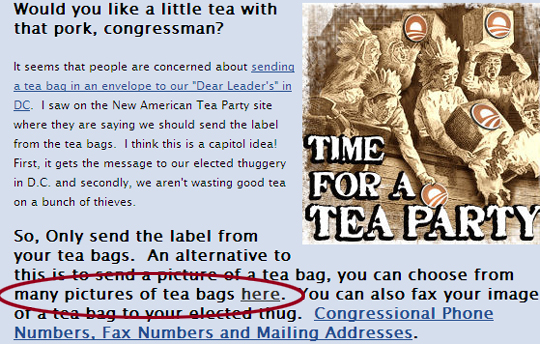
This is for Maynard Thomson, chair of the Carroll County Republicans, and romance novelist. His current writing involves some pouty revisionist history, so I thought images might help remind him of where that term that upsets him so much came from.




Thursday, December 23, 2010
Cut Spending, Cut Taxes, Jobs, Jobs, Jobs

The 2011 NH legislative session will begin on January 5. Our new state legislature will have plenty of work to do. As I write this, 888 LSRs have been filed. An LSR is a legislative service request, which is another way of saying a potential bill that might go before the legislature, after it’s been looked at by Legislative Services and examined for compliance with our state constitution, etc. The cost of each LSR filed, by the way, is approximately $1500. Good thing that 124 of the LSRs already filed were withdrawn. As it stands right now, the approximate cost to NH taxpayers for the 888 LSRs already filed is $1, 332,000. Remember, this new legislature ran on the promise of “cut spending, cut taxes, and Jobs, Jobs, Jobs.” This new group had plenty to say about the “nanny state” as well. Bearing that in mind, we should expect to see no frivolous legislation, and no gummint interference in our “personal freedoms.”
As is so often the case, what we expect to see is very different from reality. The mantra of “cut spending” seems to have been a load of tainted baloney sold to gullible voters. Our new majority in Concord seems to be focused on a very narrow social agenda., and some seem to think they were elected to Congress. Welcome to the Teabaglican nanny state. There are at least 4 LSRs that call for the repeal of NH’s marriage equality law. Interestingly, Rep. David Bates of Windham’s name is on most of them. Apparently just one bill is not enough for David Bates. He wants at least $4500 worth of assurance that gay couples are not treated equally in our state.
LSR# 0013 would repeal the Dept. of Education’s rule making authority for home education programs. In other words – eliminating standards for home schooling. This would be good news for those who would teach their kids that Noah had dinosaurs on the ark, but not necessarily good news for those kids who might want to get into a reputable college some day. Liberty University has yet to produce any Nobel Prize Winners.
Rep. Al Baldasaro of Londonderry has his name on several of the marriage equality repeal bills, too. He also is sponsoring #1168, which concerns permitting the audio and video recording of any public official while in the course of their duties. The available text reads as if he’s in favor of permitting this sort of taping, which is rather amusing, given that last year he was taped testifying before a legislative committee. In his testimony, he stated that the state of NH sells babies to gay couples for $10,000. He was forced to publicly retract that statement, because he was caught on tape.
LSR #0075 would require that all persons elected to the US Senate and House of Representatives shall take the oath of civil officers prescribed by the constitution. Al Baldasaro, Jennifer Coffey, and Dan Itse sponsor it. I’m not clear on where this fits in to “cut spending, no taxes, Jobs, Jobs, Jobs”, but I’m pretty sure it’s not worth $1500. How about LSR 0394: Ordering our federal senators to vote against the Law of the Sea Convention, sponsored by Dan Itse, who must not have any jobless folks in his district. Then there’s 0079, which concerns establishing a permanent state defense force, also sponsored by Dan Itse. I’m certain that will actually increase state spending. Given that in LSR 0223, Rep. David Hess wants to repeal all increased taxes and fees that have occurred since 2007, one wonders where the money will come from for this permanent state defense force.
With 0274, Jerry Bergevin, Kathleen Souza, Phil Grazzo, and Connie Soucy want to turn NH into a referendum state. Given that being a referendum state has destroyed California’s educational system, one can see why they’d want to emulate it. With 0806, Jonathan Malz calls for repealing the requirement that all school districts offer public kindergarten. The new legislature is also bringing back the fight over school funding.
In LSR 0629, James Summers would require random drug testing of food stamp participants. As of September, there were 51, 391 NH residents enrolled in the food stamp program, an increase of 10,000 over the previous year. A similar bill was filed last year, and NH DHHS found that each urine test would cost $55. Representative Summers proposed bill would cost the state $2,836,505. No word on where that fits in to “cut spending, cut taxes, Jobs, Jobs, Jobs”.
Locally, new legislator (and member of the John Birch Society, a designated hate group) Norm Tregenza is wavering in his commitment to “cut spending, cut taxes, Jobs, Jobs, Jobs.” He’s filed 0684, which calls for a return to the gold standard and phasing out the Federal Reserve System. With 0685, he’s one of the many, many filing a bill that opposes the new health insurance reform bill. In 0687 he would urge Congress to withdraw from the UN. Are any of those worth $1500? I hope the voters of his district will ask him how those bills will create jobs in NH.
There are also the predictable bills restricting voting. LSR 0714 would eliminate same day voter registration. #0717 simply states, “relative to eligibility to vote.” Both are sponsored by Gregory Sorg. Republicans are always in favor of making it as hard for people to vote as possible. When they win, it’s because they have a mandate. When Democrats win, it’s because of voter fraud. Just ask a Republican.
One of my favorites is 0392, “relative to official oppression,” sponsored by Dan Itse, Dan McGuire, Jack Barnes, and Paul Ingbretson. Who would know more about oppression than a bunch of white guys?
All of the LSRs filed so far are available for viewing at the NH General Court website, where you can also peruse the LSRs that have been withdrawn. Read them. Call your representatives to find out where these bills fit into “cut spending, cut taxes, Jobs, Jobs, Jobs.” Is a proposed bill worth the $1500 it will cost you, the taxpayer?
“There can be no daily democracy without daily citizenship.” Ralph Nader
© sbruce 2010
This appeared as an op-ed in the December 24 edition of the Conway Daily Sun newspaper.
Monday, December 20, 2010
Carpentry Not Recovering in Las Vegas
Building trades not experiencing recovery in Las Vegas. From WaPo:
Economists and other know-it-alls often tell the long term unemployed folks that they need to move, to go where jobs are. Anyone who has ever relocated knows it isn't that easy; it's expensive, and it may be impossible for families to sell their homes in this market.
Some of these guys are getting on toward middle age, which means they're at risk for staying unemployed.
This is the part that isn't mentioned often enough:
The long-term unemployed are seldom mentioned in the media, or in policy discussions. We need a better lobbyist.
cross-posted at MainSt/workingamerica.org
In past recessions, it has been an article of faith that as the economy revives, the work will return. But after the profound recession that began in December 2007, jobs in some industries aren't coming back.
This creates what economists call "structural unemployment," the result of a mismatch between the skills of the workforce and those needed by employers. It is feared because it causes longer unemployment spells as workers struggle to transition from one trade to another.
Economists and other know-it-alls often tell the long term unemployed folks that they need to move, to go where jobs are. Anyone who has ever relocated knows it isn't that easy; it's expensive, and it may be impossible for families to sell their homes in this market.
Moreover, the carpenters are reluctant to abandon their trade to start as a rookie in another field. Union carpenters in Nevada train as apprentices for four years. Many have had fathers or uncles in the trade. And several said they simply like to build massive projects - bridges, memorials, high-rises - and watch them "come out of the ground."
Some of these guys are getting on toward middle age, which means they're at risk for staying unemployed.
This is the part that isn't mentioned often enough:
Exactly how much of the unemployment is "structural" is a matter of debate among economists. But it evokes deep concern because it is resistant to stimulus efforts and other quick policy measures.
Already, long-term unemployment has become one of the defining aspects of the recession. The incidence of people who have been unemployed for more than six months is much higher than it has been in 60 years.
The long-term unemployed are seldom mentioned in the media, or in policy discussions. We need a better lobbyist.
cross-posted at MainSt/workingamerica.org
Those Lazy Jobless Bums
David Sirota examines the persistant myth of the "lazy jobless" in truthout:
First: as a NH resident, I'd like to apologize to all of you on behalf of my state, for sending Judd Gregg to the US Senate.
Second: Judd Gregg started working hard before he was born, thereby ensuring he was born into a very wealthy family. He knows what hard work REALLY is.
Have you noticed that the folks who spread this myth are all comfortably employed and/or independently wealthy?
This explains why the comment sections in online stories about long term unemployed and/or homeless people are filled with such horrifying comments. Many working people realize they're about 2 paychecks away from homelessness. They're scared to death of losing everything, AND being labeled lazy bums.
From merriam-webster.com
Palliate:
transitive verb
1: to reduce the violence of (a disease); also : to ease (symptoms) without curing the underlying disease
2: to cover by excuses and apologies
cross-posted at MainSt/workingamerica.org
During the recent fight over extending unemployment benefits, conservatives trotted out the shibboleth that says the program fosters sloth. Sen. Judd Gregg, R-N.H., for instance, said added unemployment benefits mean people are "encouraged not to go look for work." Columnist Pat Buchanan said expanding these benefits mean "more people will hold off going back looking for a job." And Fox News' Charles Payne applauded the effort to deny future unemployment checks because he said it would compel layabouts "to get off the sofa."
First: as a NH resident, I'd like to apologize to all of you on behalf of my state, for sending Judd Gregg to the US Senate.
Second: Judd Gregg started working hard before he was born, thereby ensuring he was born into a very wealthy family. He knows what hard work REALLY is.
The idea is that unemployment has nothing to do with structural economic forces or rigged public policies and everything to do with individual motivation. Yes, we're asked to believe that the 15 million jobless Americans are all George Costanzas -- parasitic loafers occasionally pretending to seek work as latex salesmen, but really just aiming to decompress on a refrigerator-equipped recliner during a lifelong Summer of George.
Have you noticed that the folks who spread this myth are all comfortably employed and/or independently wealthy?
Narcissism is also a factor. In a nation that typically dehumanizes the destitute Other with epithets like "welfare queen" and "white trash," our self-centered culture leads the slightly less destitute to ascribe their own relative success exclusively to superhuman greatness. The myth of the lazy unemployed plays to that conceit, helping the still-employed experience potentially scary unemployment news as a booster shot of self-aggrandizement. You remain in a job, says the myth, because you are better than the jobless.
This explains why the comment sections in online stories about long term unemployed and/or homeless people are filled with such horrifying comments. Many working people realize they're about 2 paychecks away from homelessness. They're scared to death of losing everything, AND being labeled lazy bums.
The trouble, though, is that the whole narrative averts our focus from the job-killing trade, tax-cut and budget policies that are really responsible for destroying the economy. And this narrative, mind you, is not some run-of-the-mill distraction. The myth of the lazy unemployed is what duck-and-cover exercises and backyard nuclear shelters were to a past era -- an alluring palliative that manufactures false comfort in the face of unthinkable disaster.
From merriam-webster.com
Palliate:
transitive verb
1: to reduce the violence of (a disease); also : to ease (symptoms) without curing the underlying disease
2: to cover by excuses and apologies
cross-posted at MainSt/workingamerica.org
Saturday, December 18, 2010
The Future of Pell Grants
From the NY Times:
and
This is scary news for families of college students - and a story we'll be keeping an eye on as the new Congress convenes.
cross posted at MainSt/workingamerica.org
With the lame-duck Congress winding down and a $5.7 billion gap in financing looming for next year’s Pell grants — and a further $8 billion gap for the following year — there is growing uncertainty about the future of the grants, the nation’s most significant financial-aid program for college students.
and
Earlier this year, Congress passed legislation that provided an extra $36 billion over 10 years to the Pell grant program and increased the maximum grant to $5,550, up from $4,050 five years ago. But with a new Congress arriving in January and determined to cut spending, it is unclear whether that expansion is sustainable.
If Congress does not cover the gap in financing, millions of students could see their Pell grants reduced by more than 15 percent, with the maximum grant shrinking by about $845.
Financial aid officers are starting to worry about a program that is supposed to provide more than $30 billion next year to college students.
This is scary news for families of college students - and a story we'll be keeping an eye on as the new Congress convenes.
cross posted at MainSt/workingamerica.org
Thursday, December 16, 2010
Stubborn Denial
Mitt Romney, former Governor of Massachusetts, is believed to be considering another presidential run. He recently wrote an opinion piece on the Obama tax deal for USA Today. One has to almost admire the stubborn refusal to believe what is painfully obvious: the Bush tax cuts were a failure. They did not create jobs. But Mitt is clinging to that denial, like a drowning man:
Those tax cuts have been in place for a decade. If they were going to work, they would have by now.
What Mitt has to say about unemployment insurance is particularly frightening:
He must be referring to all those jobs created by the tax cuts...?
Individual unemployment savings accounts? Just like the health savings accounts that so many of the free marketeers love so much! The fact that wages have been stagnant for decades while the costs of everything have increased sharply doesn't seem to be a consideration for this type of thinker. Of course multi-millionaire Mitt doesn't have to worry about these things. He's living quite comfortably in the top 20% of wage earners in the US, who received 49.4 percent of the income generated in the U.S. last year, according to the census.
The average working family is struggling to make ends meet as it is. That anyone is even considering the idea that these folks should have to pay into an unemployment fund is both ridiculous and frightening.
cross-posted at MainSt/workingamerica.org
Of course, delay now is better than an immediate tax hike. But because the extension is only temporary, a large portion of the investment and job growth that characteristically accompanies low taxes will be lost. When entrepreneurs and employers make decisions to start or expand an enterprise, uncertainty about tax rates translates directly into a reduced propensity to invest and to hire. With only a two-year extension, investors know that before their returns are realized, tax rates may be jacked up to the levels favored by President Obama. So while the tax deal will succeed in temporarily putting more money in the hands of consumers, it will fail to deliver its full potential for creating lasting growth.
Those tax cuts have been in place for a decade. If they were going to work, they would have by now.
What Mitt has to say about unemployment insurance is particularly frightening:
The indisputable fact is that unemployment benefits, despite a web of regulations, actually serve to discourage some individuals from taking jobs, especially when the benefits extend across years.
He must be referring to all those jobs created by the tax cuts...?
The system is also not designed for a flexible economy like ours in which some employees move from job to job for short periods, and are therefore ineligible for unemployment compensation when they are faced with a protracted spell without work.
To remedy such problems we need a very different model, perhaps establishing individual unemployment savings accounts over which employees would exercise direct control when they lose their jobs, or putting in place financial incentives for employers to hire and train the long-term unemployed. One thing is certain: While we cannot rebuild our flawed system overnight, we are surely not required to borrow the funds to pay for it. In spending $56.5 billion to extend benefits, the deal is sacrificing the bedrock Republican principle that new expenditures be paid for with offsetting budget cuts.
Individual unemployment savings accounts? Just like the health savings accounts that so many of the free marketeers love so much! The fact that wages have been stagnant for decades while the costs of everything have increased sharply doesn't seem to be a consideration for this type of thinker. Of course multi-millionaire Mitt doesn't have to worry about these things. He's living quite comfortably in the top 20% of wage earners in the US, who received 49.4 percent of the income generated in the U.S. last year, according to the census.
The average working family is struggling to make ends meet as it is. That anyone is even considering the idea that these folks should have to pay into an unemployment fund is both ridiculous and frightening.
cross-posted at MainSt/workingamerica.org
Subscribe to:
Posts (Atom)