Thursday, August 05, 2010

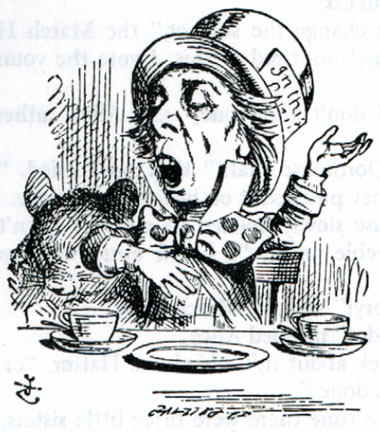
The Mad Hatter's Tea Party


This could have been a boring mid-term election season, but thankfully, we have the tea partiers to liven things up. Rand Paul, Sharron Angle, Sarah Palin – the fun just never stops. Tea Partiers complain that they’re fed up, and they’re a legitimate political movement, but it’s difficult to take them seriously when they appear to be channeling the Mad Hatter.

Take Rand Paul, the Tea Party candidate who won the Republican primary in Kentucky in the race to replace retiring US Senator Jim Bunning. Right after winning the primary, he was caught up in controversy over his remarks about the Civil Rights Act and the Americans With Disabilities Act. He said that he’s in favor of ending discrimination, but opposed to telling business owners that they can’t discriminate, and that’s pretty much what he said about the ADA. Not only did he say this stuff, he went on television to justify it. That didn’t go well for him. Apparently the GOP hasn’t been able to reel him in, because he steps in it every time he opens his mouth. After the Deepwater Horizon explosion, where 11 people were killed, and millions of gallons of oil drained into the ocean, Mr. Paul’s sympathies were with BP. He told Good Morning America that “accidents happen” and that President Obama was “un-American in his criticism of business.”

Shortly after that, the disavowals began. Mark Meckler of the Tea Party Patriots said of Rand Paul, “He’s a politician. HE doesn’t represent the movement on anything regardless of what he says.”

Since then, Rand Paul has gone on to further distinguish himself with his knowledge of coal mining in Kentucky. At a campaign stop at the Harlan Center, Paul was asked about the disaster at the Big Branch Mine, where 29 miners were killed. Paul said,” "Is there a certain amount of accidents and unfortunate things that do happen, no matter what the regulations are?" Paul says at the Harlan Center, in response to a question about the Big Branch disaster. "The bottom line is I'm not an expert, so don't give me the power in Washington to be making rules. You live here, and you have to work in the mines. You'd try to make good rules to protect your people here. If you don't, I'm thinking that no one will apply for those jobs.” It’s a charmingly naive Libertarian viewpoint, to think that no one will apply for jobs in a dangerous setting, but it’s not based in any kind of reality. The mine had been cited for over 1300 safety violations over a 5-year period. Sometimes an accident is not an accident. This Randian philosophy hasn’t endeared him to coal miners, who rely on safety regulations to protect them. Paul also believes that business should be self-regulating, a tired bit of baloney that is continually recycled by people who work behind desks.

Another Tea Partier running for the US Senate is Sharron Angle of Nevada. Last week, I mistakenly gave her credit for the plan to barter health care for chickens. That was Sue Lowden, who was apparently so crazy that Sharron Angle defeated her in the primary. Angle’s been in the news this week, because a reporter unearthed an interview where she discussed her belief that the agenda of the Democrats are a “violation of the first commandment.” Not amendment. Commandment. Angle is in favor of a theocracy, and in her view, social programs being pushed by Democrats are turning our government into God. Apparently Ms. Angle’s Bible is uncluttered with all that stuff about compassion, and caring for the poor and needy. Angle is opposed to abortion even in the case of rape or incest. She advocates that young women pregnant by rape or incest should “turn lemons into lemonade” by having the baby. One wonders if she would counsel a family member in the same way – and one is certain that Ms. Angle has never been raped. She wants to make Nevada the spent nuclear fuel capital, by promoting the waste dump at Yucca Mountain. Angle also called the escrow fund for victims of the oil spill set up by BP “a slush fund.” She backtracked on that pretty quickly, though; later saying it was “an important first step.” In any case, a Republican with a pulse and a flag lapel pin should be able to beat Harry Reid in this election – but Tea Party Sharron is apparently too crazy for Nevada.

Meanwhile, back home in New Hampshire, the Tea Party is hard at work. Tea Partiers claim to be opposed to government interference, but it’s hard to see any sign of that at the NH Tea Party Coalition website. They’re opposed to marriage equality – which means they support government interference in our private lives. They’re opposed to abortion, which means they support government interference in women’s lives. They claim that schools are for brainwashing children, which does make a certain amount of sense. People who lack literacy and critical thinking skills would be far more likely to blindly follow these Tea Partiers. There’s plenty of talk about “socialism” a term always erroneously used by teabaggers and Republicans. They support the Arizona immigration laws, but they aren’t racists.

Of course not. Tea Partiers claim to be defenders of the Constitution, and angry about runaway government spending. It’s surely a coincidence that they ignored the Patriot Act and the decadent spending of the Bush administration – and chose to form up during the administration of our first black president. Are we the Dormouse, or are they?


“Up above the world you fly,
Like a tea tray in the sky.
Twinkle, twinkle, little bat!
How I wonder what you're at!”


The Mad Hatter, in Lewis Carroll’s Alice in Wonderland


published as an op-ed in the August 6, 2010 edition of the Conway Daily Sun
© sbruce 2010

Job insecurity and Stagnant Wages

Financial Insecurity in the USA

Insecurity in America is on the rise—and was even before the Great Recession.

The Rockefeller Foundation just released a study of economic insecurity in America, which was developed by Yale professor Jacob Hacker and measures harsh changes in circumstance: For example, it reveals how many Americans have been subjected to a staggering decline of 25 percent of "available household income," either from loss of income or sudden, unanticipated out-of-pocket medical costs, and how many were without the savings to buffer the damage. Brutal losses such as these take six to eight years to recover from, the report said.


A 25% decline in household income? Surely this can't be common.

Economic insecurity affected 12.2 percent of Americans in 1985 and spiked to 17 percent during the 2000 downturn. In 2007, when economists were celebrating "the Great Moderation," insecurity was higher than in 1985, affecting 13.7 percent of Americans. In 2009, after the downturn, Hacker estimates that one in five Americans was hit with a 25 percent decline in available household income. And the report estimates that between 1996 and 2006—before the collapse—fully 60 percent experienced such loss.

One in five families in 2009? That's pretty common.

But Ben Bernacke says:

Federal Reserve Chairman Ben S. Bernanke said rising wages would probably spur household spending in the next few quarters, even as weak job gains dragged down consumer confidence.

He never tells us where these rising wages will come from. Wall St. would be my guess.

On Main St. workers are actually being subjected to pay cuts:

The furloughs that popped up during the recession are being replaced by a highly unusual tactic: actual cuts in pay.

Local and state governments, as well as some companies, are squeezing their employees to work the same amount for less money in cost-saving measures that are often described as a last-ditch effort to avoid layoffs.


Let's be clear. These are not pay freezes - these are actual pay cuts.

It is impossible to say how many employers have cut workers’ pay, because the government does not keep such statistics. Economists say a modest but growing number of employers have ordered wage cuts, especially in the public sector. In a 2010 survey by the National League of Cities, 51 percent of the cities that responded said they had either cut or frozen salaries of city employees, 22 percent said they had revised union contracts to reduce some pay and benefits, and 19 percent said they had instituted furloughs.

Some businesses are also cutting workers’ pay, often to help stay afloat or to eliminate their losses, although a few have seized on the slack labor market and workers’ weak bargaining power to cut pay and thereby increase their profits and competitiveness.


Right now workers will agree to almost anything to stay employed and some businesses are willing to hold workers hostage by threatening their jobs.

At a time when the official unemployment rate is nearly 10%, it's shocking to learn that USAID (US Agency for International Development) is contributing to train offshore IT workers:

Despite President Obama's pledge to retain more hi-tech jobs in the U.S., a federal agency run by a hand-picked Obama appointee has launched a $36 million program to train workers, including 3,000 specialists in IT and related functions, in South Asia.

Following their training, the tech workers will be placed with outsourcing vendors in the region that provide offshore IT and business services to American companies looking to take advantage of the Asian subcontinent's low labor costs.

Roger Smith spoke with the CEO of Engine Yard, Lance Walley, about their Ruby and Rails deployment platform.
Under director Rajiv Shah, the United States Agency for International Development will partner with private outsourcers in Sri Lanka to teach workers there advanced IT skills like Enterprise Java (Java EE) programming, as well as skills in business process outsourcing and call center support. USAID will also help the trainees brush up on their English language proficiency.

USAID is contributing about $10 million to the effort, while its private partners are investing roughly $26 million.


This is one unholy partnership. USAID is working with US companies (using some of our tax dollars) to help them avoid paying US labor costs by training overseas workers to get jobs, at a time when so many Americans are out of work.

The mind boggles.


Originally posted at MainSt/workingamerica.org

Tuesday, August 03, 2010

Robbing the Poor Instead of Cutting Corporate Welfare

States are begging for federal aid. And this week, the Senate is voting on an aid package that would give states Medicaid dollars, as well as money to keep teachers on the payroll. There is a catch. The money for this aid will be taken from SNAP, the Supplemental Nutrition Assistance Program - formerly known as food stamps.

That's right. To pass this aid package, the Senate is willing to take food away from children and families:

But to gain the votes of the Republicans necessary for passage, the bill includes “pay fors” to make it deficit-neutral. There is language to close a foreign tax credit loophole, raising $9 billion. Billions more come from tinkering with Medicaid drug prices and rescinding unspent funds from a variety of programs. But controversially, the bill will also likely slash $6.7 billion from the Supplemental Nutrition Assistance Program, or SNAP, the benefits formerly known as food stamps. This might result in a cut in benefit checks from one month to the next — an unprecedented event in the history of the benefit.

American food stamps are not generous, averaging only $4.50 a day even after being bumped up in the recession-era stimulus — less than you’d need to buy two meals at McDonald’s. And since the start of the recession, the number of families depending on them has skyrocketed. The economic crisis has pushed 12.9 million people into SNAP; as of April, more than 40 million collect the bare-bones benefits. More than 6 million Americans report no income whatsoever except for SNAP — because they are not eligible for unemployment insurance, Social Security, disability or other programs.

and:
Still, the suggestion caused outrage on the Hill. The House Appropriations Committee originated the education-jobs provision in a war supplemental bill, and in an interview with the Fiscal Times, its chair, Rep. Dave Obey (D-Wis.), first revealed that the White House had suggested cutting SNAP early in the summer.

“We were told we have to offset every damn dime of [new teacher spending]. Well, it ain’t easy to find offsets, and with all due respect to the administration their first suggestion for offsets was to cut food stamps. Now they were careful not to make an official budget request, because they didn’t want to take the political heat for it, but that was the first trial balloon they sent down here,” he said.


It ain't easy to find offsets? He's joking, right?

But this is also a question of priorities, of what gets cut. Bernie Sanders put up an amendment last month to cut about $35 billion in oil and gas subsidies. It failed. Republicans are arguing to extend Bush's tax cuts for the rich with no offsets, and they may well succeed. But food assistance for poor families? You can get the votes to slash those.


How can this be? Sadly, it all comes down to money and influence:

The oil and gas industry, of which BP is a member, reported $169 million in 2009 lobbying expenditures.


Poor people spent $0 on lobbying.


Originally posted at Main St/workingamerica.org

Tuesday, July 27, 2010

More Stories of the New Homeless

A while back I wrote about The New Homeless, and took a look at why it is we hear so little about them. In 2009, tent city stories were all the rage. In 2010, the most visible tent cities have been broken up and residents dispersed by the town fathers. As the numbers of homeless families increase, the media coverage decreases. A little digging finds a few stories:

In the Las Vegas Sun:

Before the recession, Michelle and her then-boyfriend, John Brower, led a relatively happy life. He worked at a grocery store, she as a waitress and then at the crafts store. She hoped to go back to college.

Like thousands of other residents, the Browers, now married, had lived paycheck to paycheck. They teetered on the brink of homelessness for the better part of a decade. If one of the longtime Las Vegans lost a job, eviction wasn’t far behind.


They wound up living in a tent in a homeless encampment in the desert. Michelle was pregnant.

But getting out of the desert is harder than ever amid the recession, the Browers say. You need to create and print resumes, you need a phone, and you need clean clothes for interviews. Getting all of that lined up takes a lot longer when you have to ride a bus for two hours across town just to shower and the only phone you have is at a friend’s house.

and

In 2009, an estimated 13,350 homeless people were in Clark County, according to county records. That’s 17 percent over 2007 numbers.

Of those, about 6,640 were living on the streets or in the desert.

The National Alliance to End Homelessness says that’s a drop in the bucket. The group says there are 39,760 Nevadans, mostly in Southern Nevada, couch surfing or in families that are “doubling up” in single-family homes to share expenses. It claims Las Vegas has the fourth highest homelessness rate in the country, behind Detroit, New York City and Los Angeles.


Maybe I'm being naive, but shouldn't nearly 40,000 homeless folks in the southern part of one state be a big news story?


A recent NPR story looked at the phenomenon of homeless college students:

Antonio Sandoval, head of UCLA's Community Programs Office, says he doesn't have the exact number of students experiencing the day-to-day hardship of food and shelter because they often keep it hidden.

"It's very affluent here, it's Westwood, Bel Air, Beverly Hills," Sandoval says. "Students who come to UCLA want to fit the norm here, so they're not going to tell you they're homeless, or they're not going to tell you they're hungry.

Just down the hall from Sandoval's office is an unmarked door. Inside is a converted utility closet filled with food. There's a refrigerator stocked with fruit cups, yogurt, juices and milk. Next to the fridge is a pantry.

"It has a lot of soups and main meals you can cook like macaroni and cheese," explains Abdallah Jadallah, a 22-year-old engineering student.

Jadallah says he got the idea for the food closet after noticing a number of students were going hungry. The food is donated..


As Antonio Sandoval points out - this is at UCLA, which is smack dab in the middle of California affluence. Imagine the stories that aren't being reported in the other 49 states.

HBO is currently showing a new documentary called Homeless: The Motel Kids of Orange County

The film takes a look at the lives of families who work hard, but don't earn enough money to be able to afford housing in one of the wealthiest areas in the nation - and what life is like for children growing up with no fixed address.


Originally posted at Main St/workingamerica.org

So Much for the Conventional Wisdom

We keep hearing that when the economy begins to turn around, businesses will start to hire. Well, it ain't necessarily so:

Motorcycle sales are falling in 2010, as they have for each of the last three years. The company does not expect a turnaround anytime soon.

But despite that drought, Harley’s profits are rising — soaring, in fact. Last week, Harley reported a $71 million profit in the second quarter, more than triple what it earned a year ago.


That's impressive! But:

Many companies are focusing on cost-cutting to keep profits growing, but the benefits are mostly going to shareholders instead of the broader economy, as management conserves cash rather than bolstering hiring and production. Harley, for example, has announced plans to cut 1,400 to 1,600 more jobs by the end of next year. That is on top of 2,000 job cuts last year — more than a fifth of its work force.


and:

Because of high unemployment, management is using its leverage to get more hours out of workers,” said Robert C. Pozen, a senior lecturer at Harvard Business School and the former president of Fidelity Investments. “What’s worrisome is that American business has gotten used to being a lot leaner, and it could take a while before they start hiring again.”


What's worrisome to me is that businesses may choose to perpetuate high unemployment.

Harley has warned union employees at its Milwaukee factory that it would move production elsewhere in the United States if they did not agree to more flexible work rules and tens of millions in cost-saving measures.


This could be a frightening new US reality - companies holding workers hostage, in exchange for jobs.


originally posted at MainSt/workingamerica.org

Thursday, July 22, 2010

Granny Grizzly's Latest Endorsement


Sarah Palin, self-styled “Mama Grizzly” (which apparently sounds more Alaska folksy than "lipstick wearing pit-bull") endorsed US Senate candidate Kelly Ayotte this week. Ms. Ayotte is one of the seven Republicans in the field of 14 candidates running to replace retiring Senator Judd Gregg. Apparently Ms. Ayotte is thrilled to be chosen as a “Mama Grizzly” since Palin’s endorsement is the very second thing one sees on her website. The first thing one sees is a face shot of Sarah Palin. The third thing one notices is a rather odd profile shot of Ms. Ayotte, taken from the back. Apparently the endorsement of the linguistically, geographically, and factually challenged Palin is quite a coup. Mrs. Palin has also endorsed Sharonn Angle, who is running for US Senate against Harry Reid, in Nevada. Angle proposed returning to the health care system where folks paid for medical care with chickens. Palin also endorsed Rand Paul of Kentucky, who hasn’t been able to take his foot out of his mouth since he won the primary. Maybe she likes his shoes. The most amusing bit of fallout from the grizzly endorsement of Ayotte was a front page comment in the Union Leader from Joe McQuaid, who seems quite unimpressed with Mrs. Palin.

Sarah Palin and Kelly Ayotte do have some things in common. Both are considered politically conservative. Palin is trying to recreate herself as a “conservative feminist,” which Ayotte, so far, has (wisely) steered clear of, despite the fact that both of them are against a woman’s right to bodily autonomy and reproductive choice. Palin praised Ayotte, claiming she “battled all the way to the US Supreme Court to protect the rights of NH parents – and won!” It’s true that as NH Attorney General, in 2005, Ayotte defended an NH parental notification bill before the Supreme Court. It’s also true that SCOTUS sent the case back to the federal court that declared it unconstitutional, because it made no exception for the possibility of a medical emergency that could threaten the health or even life of a minor child. The law was later repealed. This is hardly the victory that Palin is claiming it was – but – she and Ayotte are both counting on the fact the media is little more than a stenographer for the GOP, especially in NH. The obedient media does not question or counter misinformation or even outright lies.

There are the occasional exceptions. NHPR’s Josh Rogers took Kelly Ayotte to task last week for one of her favorite outright lies. Ayotte has repeatedly stated that Arizona has the second highest rate of kidnapping in the world. This isn’t true. She’s been made aware that it isn’t true, yet she continues to say it. According to a May 2010 story by Dennis Wagner in the Arizona Republic, the crime rate along the Arizona border has remained flat for the last decade. Statewide, rates of violent crime are down. The sheriff of Pima County calls all of the rhetoric, “a media created event.” Arizona Senator John McCain has generated plenty of that rhetoric himself, and now he’s being assisted by Kelly Ayotte. Take some time to ponder the recent revival of the immigration issue, and how “urgent” it has become. Think about when immigration started to become a hot topic again. Then think about what’s coming up in November.

What are most working folks concerned with right now? Either keeping their jobs or finding one. What are they getting from the politicians on the right? A lot of distraction about immigration, abortion, and marriage equality. This is all meant to divert attention from the sad reality that the GOP hasn’t any kind of plans to offer – just the usual cut taxes and cut spending baloney, served up with a side of dishonesty. Oh, how they wail that we are being taxed too much – yet in 2009, we paid lower federal taxes than we have since 1950. The Bush tax cuts, once touted as the fastest way to create jobs, are still in place, yet the jobs never materialized. The Republicans have been trying since the Reagan years to convince us that tax cuts for the wealthy are the way to create employment. It hasn’t worked. If it did work, over 5 million jobs would not have been lost during the Bush administration. It doesn’t work – but that won’t deter our doughty friends on the right from doing their best to help the rich get even richer.

Foster’s Daily Democrat published an opinion piece by Kelly Ayotte this week, where she promises that cutting taxes will jump start the economy. She also promises she will end the “death tax” which is what the defenders of the wealthy like to call the estate tax. They used to wail about how the death tax would kill family farms, before it was proven that hardly any family farms would be affected. NH abolished the estate tax some years back. Naturally, the one thing Ms. Ayotte doesn’t propose cutting is the defense budget. The GOP is only too happy to keep on borrowing and spending to perpetuate the war machine.

There is one more thing that Palin and Ayotte have in common. They’re both quitters. Sarah Palin quit her job as governor of Alaska, before finishing her first term. Kelly Ayotte quit her job only months after promising Governor Lynch that she would serve a full second term as NH AG. Ms. Ayotte was appointed to her first term by the GOP Governor-of-Whom-We-Don’t-Speak: Craig Benson.

"I like being here, because it seems like here and in our last rally too -- other parts around this great Northwest -- here in New Hampshire you just get it." Sarah Palin in Laconia, 2008


published as an op-ed in the Conway Daily Sun newspaper, July 23, 2010

© sbruce 2010

Becoming Less Invisible

The long term unemployed are finally becoming less invisible. From the PBS The Nightly Business Report:

DARREN GERSH, NIGHTLY BUSINESS REPORT CORRESPONDENT: The official figures will tell you there are 1,371,000 people like Randy Moe.

RANDY MOE, 99ER CHICAGO: I was unemployed, laid off, August 15, 2008, and collected benefits until about six weeks ago.

GERSH: That's because Moe hit the limit on benefits. In most states, that's 99 weeks, which is why many of those who have run out call themselves "99ers."

MOE: We've become thrown away people. They're losing a lot of valuable people, the country is.

GERSH: Randy Moe found other 99ers online. A dozen meet regularly in this chat room. They talk about finding a job and about lobbying Congress for help. They're part of a grassroots movement to add what's called a tier five to unemployment insurance -- another 20 weeks of benefits.


Websites for the unemployed are cropping up:

Jobless Bloggers

No Job Survivor

Survive Unemployment News Blog

Unemploymentality

Unemploymentality has a lot of links to other unemployed bloggers, some helpful options (look for Broke-Ass Stuart's money saving recommendations) and there's also plenty of entertainment.

The only way to end long term unemployment is to put a human face on it.


cross posted at Main St/workingamerica.org

Wednesday, July 14, 2010

Senate Gamesmanship Hurting Families

Those pesky unemployed folks - from WaPo:

Even before his unemployment checks ended, Dwight Michael Frazee's days were filled with the pursuit of any idea that could earn him a buck. But few are working out, and now his nights are filled with dread.

In the coming weeks, the Senate is expected to resume its debate about whether to extend the emergency jobless benefits that were passed in response to the steep increase in unemployment caused by the recession. But people like Frazee, who have suffered the longest in the downturn, will not be part of that conversation. They are among the 1.4 million workers who have been unemployed for at least 99 weeks, according to the Labor Department, reaching the limit for the insurance. Their numbers have grown sixfold in the past three years.

The 99ers are glaring examples of the nation's most serious bout of long-term joblessness since the Great Depression. Nearly 46 percent of the country's 14.6 million unemployed people have been out of work for more than six months, and forecasters project that the situation will not improve anytime soon. Currently, the Labor Department says there are nearly five unemployed people for every job opening.


As grim as the news is, at least the media is beginning to cover actual stories of folks who are amongst the long term unemployed.

The Grand Junction Sentinel takes a look at an unemployed single father:

Daniel Stark didn’t have the best Fourth of July weekend of his life.

That’s because the Clifton resident is worried about the immediate future for him and his 6-year-old son, Isaiah.

Stark has been unemployed for more than a year and is about to see his unemployment benefits run out. He’s angry not only because he can’t find a new job, but also because Congress hasn’t extended those benefits.

A bill to do that has stalled in the U.S. Senate several times.

“I’ve talked to everyone, my senators, my congressman,” he said. “They need to know that they’re impacting people who are really hurting. A lot of people are scared to tell them that, but I’m not. I just want this to be over so I can find work.”


Stark and his son have already spent time in a homeless shelter. That's the reality of the game that is being played out in the Senate.

Ezra Klein in the WaPo gives us a look at the numbers of long term unemployed since the 50's:


Klein asks:

Unemployment is likely to remain above 9 percent for the rest of this year, and for much of next. That means the ranks of the long-term unemployed will swell even further. As you can see in the graph atop this post, that's been the trend so far in this recession, and it's not likely to stop now. And we're just going to leave them without incomes and without job opportunities and without money to spend in their wrecked local economies -- thus making it harder for those economies to generate new jobs? That's the economic theory this country is going to embrace amid terrible joblessness?

Sadly, this does seem to be the economic theory that the US intends to embrace. That's why, in my humble, long-term unemployed opinion, the stories of what this is doing to people must be told. Loudly.


cross-posted at Main St/workingamerica.org

Monday, July 12, 2010

Census Jobs Ending

The temporary census jobs are wrapping up, and hundreds of thousands of newly unemployed workers will be pouring in to the already flooded job market:

Now, its decennial work largely done, the Census Bureau is shedding hundreds of thousands of workers — about 225,000 in just the last few weeks, enough to account for a jot or two in the unemployment rate, say federal economists. Most of those remaining will be gone by August; a few will last into September.

Usually the census has trouble getting enough people to stay on to finish the job. Not this year:

“Typically, at this point in the process, we’re losing a lot of people because they’re taking jobs,” said Kathleen Ludgate, the regional director in Boston. “I wish we had that problem now.”

Ms. Ludgate receives notes from departing workers, some by e-mail, others in ink. They thank her for the chance to learn something about themselves and their country. They write to say their confidence had picked up, that they can again meet the gaze of friends and neighbors.

These are the missives of hard-working people who found themselves in a tighter spot than they ever expected, and who came to view census work as a lifeline.

Many are middle-aged. The census offices in Providence and Bridgeport, Conn., offer a sea of gray-haired men and women in neat office garb. They work with an intensity that suggests they would rather concentrate on the task at hand than the fast-approaching end.


How will this affect the unemployment numbers? From The Atlantic:

According to these projections and the actual results in June, it would mean a summer of 329,000 net job losses. It could take until winter before the labor market gets those back through three months of net positive gains, unless jobs grow at a rate of more than 110,000 per month starting in September. That might not sound like much, but so far this year, only two months -- March and April -- have seen non-Census job growth exceed 100,000.

At this rate, millions of unemployed people are likely to be unemployed for years to come.


cross-posted at Main St/workingamerica.org

Thursday, July 08, 2010

NH's Rand Paul


New Hampshire has a primary election in September that will winnow the field of candidates for some of the races. One of the GOP gubernatorial hopefuls recently stopped by the Conway Daily Sun, for an interview. Jack Kimball is a seacoast area businessman, who described himself as the “warrior” in the race. (Some men never recover from high school football.) He was honest enough to say that he’s not “the establishment” candidate. This is true. He’s called Glenn Beck an “American hero,” which reportedly provoked a fresh outburst of Beck tears. Kimball is a tea partier, and a member of Beck’s 912 Project. This is the same Glenn Beck who said, “But when I see 9/11 victim family, you know, on television, or whatever, I’m just like, ‘Oh, shut up.’ I’m so sick of them. Because they’re always complaining.” Some hero.

Jack Kimball achieved national notoriety on April 15, when he spoke at the Concord Tax Day Tea Party rally. That day the tea partiers had a number of events around the state to show their ire at paying taxes. They were in Market Square in Portsmouth, at the docks in Wolfeboro, and in front of the State House in Concord. All of these are public places, paid for by – you guessed it! The very same tax dollars that the tea partiers are so opposed to paying. The Concord Monitor quoted Kimball:

In Concord, gubernatorial candidate Jack Kimball drew cheers with an anti-tax message. He decried the state's taxation of business while criticizing its relatively low level of services."I don't mind paying my fair share, folks," he said. "I don't think any of us do. But I do mind when I'm raped. It's awful."

News outlets and blogs around the nation picked up on Mr. Kimball’s trivialization of a serious crime, used to score cheap political points. If Kimball ever had a man put a gun to his head and rape him, or a group of men beat him up, hold him down and gang rape him, he wouldn’t be using the term so blithely. One in six women is raped during her lifetime. One in four women on college campuses is raped. One in three women serving in the US military in Iraq is going to be raped by a fellow soldier. One in 33 men will be raped in his lifetime. The Concord Monitor got so much mail about the story on Kimball, he felt compelled to offer up a very GOP apology:

“I used the term ‘rape’ talking about taxation at the Tea Party in Concord. I think the Concord Monitor took the remark out of context and there has been a lot of negative reaction. People that know me know that I don’t say things to purposefully hurt people. “I want to apologize to anyone that is offended. My remark was clearly not intended to offend people.”

Not exactly a foray into the land of personal responsibility. I’ve listened to the tape. That is exactly what he said – that is the context. In this insincere excuse Kimball blames the CM for taking his remarks out of context. He blames people for being offended. The one thing he doesn’t do is offer a sincere apology.

Jack Kimball is also well known for the reader board sign in front of his business on the Route 1 Bypass in Portsmouth. He uses the sign to express his beliefs like, “NH has the highest business taxes in the US.” According to the Small Business and Entrepreneurial Council, NH doesn’t even make the top ten list of states with the highest business taxes. Four New England states make their top ten list, but NH isn’t one of them. New Jersey is number one. This dishonest bit of hyperbole is especially disappointing coming from one of Beck’s 912 Project acolytes. The third of the project’s nine principles is: “I must always try to be a more honest person than I was yesterday.” It does say try. No mention of succeed.

Kimball’s website is all that one would expect from a far right Republitealican. Lots of commentary about liberty and freedom from gummint interference, while informing us that he’s against a woman’s right to bodily autonomy and opposed to marriage equality. All that liberty and freedom is for folks who aren’t female or gay. He recites the standard issue NH GOP mantra, “NH doesn’t have a revenue problem, NH has a spending problem.” He blames business taxes for everything. No mention of property taxes. No mention of the role that the Bush administration played in destroying the US economy. The magic slate of Bush responsibility was wiped clean the day Obama took office -isn’t that right, Ralph from Eaton?

Kimball has a lot to say about socialism, so I was shocked to learn that he actually supports socialist practices. The free market doesn’t support nuclear power, which is why no plants have been built in over 30 years. The US Dept. of Energy has $18.5 billion in loan guarantees for nuke plant builders in 2010. Obama has asked for $35.5 billion in the 2011 budget. Included in the emergency supplemental bill passed by the House on July 1 was $9 billion more for new nuke loans. Let’s be clear – these are loans. If the loans are defaulted upon, we the taxpayers pick up the tab. As I’ve pointed out before, the nuclear industry is one long taxpayer subsidy from inception to decommissioning. The taxpayers pay for the building of the plant, pay for insuring the plant, pay for the cleanup if there’s an accident, and pay for the decommissioning, which is always more than the owners have saved up for. The only thing the taxpayers don’t get is a share in the profits. The most devoted free marketers seem to find socialist nuclear power perfectly acceptable.

Kimball’s list of endorsements is full of people you’ve never heard of. The NH GOP seems to be lining up behind John Stephen. Stephen, though better known, is joining the ranks of Jim Coburn and Joe Kenney as the latest sacrificial lamb to be led slaughter against the popular Governor Lynch. I’m betting that NH GOP Chairman John Sununu Sr. would be about as happy to have Kimball win the primary as the Republicans in Kentucky were to end up with Rand Paul. The tea partiers are even nuttier than the standard issue GOP, and that’s saying something.

“Finally a guy who says what the people who aren’t thinking are thinking.”
Jon Stewart


Published in the Conway Daily Sun on July 9, 2010
© sbruce 2010

States Continue Layoffs

The city of Lawrence, MA has just laid off 23 firefighters, and closed a third fire station, in an attempt to balance the budget. This is especially alarming in a city that has been called "the arson capital of the world."

The Los Angeles County Office of Education has just laid of 177 employees.

In Grand Rapids, Michigan the school board approved layoff notices to 71 employees.

The Miami-Dade budget, recently proposed by the mayor, includes 900 layoffs.

In New Orleans, 38 civilian members of the police department and 12 recruits training at the Police Academy were fired:

Twenty-three of the dismissed employees were communications operators, which are the people who staff the 911 lines that take emergency calls.

In a city troubled by violence and high muder rates, this is quite disturbing.

No word from the deficit peacocks on how having even more unemployed folks with fewer dollars will help decrease the deficit.


cross-posted at Main St/workingamerica.org

Tuesday, July 06, 2010

Lessons We Failed to Learn in 1928

Robert Reich in The Nation:

Wall Street's banditry was the proximate cause of the Great Recession, not its underlying cause. Even if the Street is better controlled in the future (and I have my doubts), the structural reason for the Great Recession still haunts America. That reason is America's surging inequality.

Consider: in 1928 the richest 1 percent of Americans received 23.9 percent of the nation's total income. After that, the share going to the richest 1 percent steadily declined. New Deal reforms, followed by World War II, the GI Bill and the Great Society expanded the circle of prosperity. By the late 1970s the top 1 percent raked in only 8 to 9 percent of America's total annual income. But after that, inequality began to widen again, and income reconcentrated at the top. By 2007 the richest 1 percent were back to where they were in 1928—with 23.5 percent of the total
.


Apparently we didn't learn anything at all from the Depression. Only fifty years later:

But starting in the late 1970s, and with increasing fervor over the next three decades, government did just the opposite. It deregulated and privatized. It increased the cost of public higher education and cut public transportation. It shredded safety nets. It halved the top income tax rate from the range of 70–90 percent that prevailed during the 1950s and '60s to 28–40 percent; it allowed many of the nation's rich to treat their income as capital gains subject to no more than 15 percent tax and escape inheritance taxes altogether. At the same time, America boosted sales and payroll taxes, both of which have taken a bigger chunk out of the pay of the middle class and the poor than of the well-off.


It makes one wonder why we bother to study history at all. Unless we're willing to engage in stern regulation and address the structural problems, this sort of economic devastation will continue to occur.

Containing the immediate financial crisis and then claiming the economy was on the mend left the public with a diffuse set of economic problems that seemed unrelated and inexplicable, as if a town's fire chief dealt with a conflagration by protecting the biggest office buildings but leaving smaller fires simmering all over town: housing foreclosures, job losses, lower earnings, less economic security, soaring pay on Wall Street and in executive suites.


Precisely. The "small people" are left holding the bag, while Wall St. and the banks rake in the big pay and bonuses. Again.


cross-posted at MainSt/workingamerica.org

Thursday, July 01, 2010

Even More Bad News

Home Sales and construction are slowing down:

A slowdown in the housing and construction markets contributed to a sluggish outlook for the economy Thursday, highlighting the significance of government stimulus and job creation.

According to new statistics, pending homes sales and construction both declined in May. In addition, figures showed that while manufacturers recorded some gains in June, the pace of activity in that sector slowed last month compared with May and also came in slightly below estimates.


Auto Sales Down:

New-vehicle sales in the United States slowed in June, automakers and analysts said, raising concerns that the market’s recovery could be stalling after months of slow but encouraging gains.

The jobless sure are messing things up for the market's recovery.
This isn't likely to change any time soon. The hiring outlook isn't good:


The weak private sector job growth, coupled with the loss of more than 200,000 census jobs in June, has economists surveyed by Briefing.com forecasting an overall loss of about 100,000 jobs for June. The government will release those figures Friday. The unemployment rate is expected to rise to 9.8% from 9.7% in May.

The Senate failed again to pass an extension of unemployment benefits.

Lurking beneath the deficit concerns for some members is the suspicion that the extended benefits discourage people from looking for work -- even though there are five people vying for every available job and a full third of the 15 million unemployed don't actually receive the benefits.

If Congress eventually does reauthorize the aid, people eligible for extended benefits during the lapse will be paid retroactively. Failure to do so would be unprecedented: Since the 1950s extended federal benefits have never been allowed to expire with a national unemployment rate above 7.2 percent. The current rate stands at 9.7 percent.


The deficit peacocks claim that extending benefits will increase the deficit. No word on how the deficit will decrease with even more people out of work living in poverty.


cross-posted at MainSt/workingamerica.org

Wednesday, June 30, 2010

Dismal Job Numbers Coming for June

From the Washington Post:


The recession has directly hit more than half of the nation's working adults, pushing them into unemployment, pay cuts, reduced hours at work or part-time jobs, according to a new Pew Research Center survey.


The story focuses on how the economic devastation will cause people to live more austerely and save more money, which would certainly be good.

"We're going to see much lower consumption going forward," said Dean Baker, co-director of the Center for Economic and Policy Research. He blames diminished spending on the drop in housing prices. "People who thought they had equity in their homes have seen it disappear," he said.

Again, consuming less is certainly not a bad thing - except that our largely service based economy is fueled by consumer spending. If people are saving money instead of buying new stuff or going out to eat, more jobs will be lost. And speaking of job creation....

The numbers look dismal for June:

The private sector of the U.S. economy added only 13,000 jobs in June, according to ADP employment services, a disappointing number that came in below estimates and portends bad things from the government's June jobs report due out Friday.

In May, according to ADP, the private sector added 57,000 jobs. But in June? Statistically, across a workforce as big as the United States'? Zero job growth; 13,000 new jobs is a statistically meaningless number.


It's also a realistically meaningless number, in the face of the 22 million jobs that need to be created in order for the US to even be approaching full employment.

There is no such thing as a "jobless recovery."


cross-posted at Main St.workingamerica.org

Thursday, June 24, 2010

Power With No Accountability


The CIA has recently given Xe Services a $100 million contract to guard its facilities in Afghanistan and other, unspecified locations. A day earlier, members of a federal commission investigating military contractors expressed deep unhappiness that the State Dept. had just granted Xe a new contract for $120 million to guard US consulates being built in Afghanistan. More specifically, this is for 2 consulates being built. Apparently they’ll be very secure. Certainly far more secure than Afghani civilians.

Xe Services is a private military firm that was formerly known as Blackwater. In 2007 the company changed their name, in the hopes of duping us into forgetting the many crimes that they’ve been charged in Iraq. The name change was intended to be a whitewash. It does seem to have been successful, given that the US govt. is giving them new contracts after Blackwater was essentially thrown out of Iraq.

Private military firm is a euphemism for mercenaries. Companies like Blackwater are hired to provide security. They have an enormous amount of power, and no accountability to any government.

In Iraq, in 2005, Blackwater guards escorting a State Dept. convoy opened fire on an Iraqi car. They felt threatened by the car’s approach, so they shot 70 rounds into the car, and kept going. The State Dept. found the shooting unjustified, and found that the Blackwater employees gave false statements.

On Christmas Eve, 2006, a security guard for Iraq Vice President Adel Abdul Mahdi was shot and killed on duty. The Iraqi government accused Blackwater employee Andrew Moonen of killing the guard while intoxicated. Blackwater shipped Moonen back to the US in a hurry, and Blackwater and the State Dept. tried to keep Moonen’s identity a secret, apparently to enable him to avoid being prosecuted by the Iraqi govt. In 2007, he was employed by another US defense contractor in Kuwait.

In May 2007, a Blackwater sniper on the roof of the Iraqi Justice Ministry fired and killed 3 guards working for the Iraqi Media Network. Witnesses reported that the guards had not fired at the Justice Ministry. The Iraqi police described this as “an incident of terrorism.” The State Dept, however, found that the actions fell “within the approved rules governing force.”

In September of 2007, Blackwater guards shot and killed 17 unarmed civilians in Nisour Square, Baghdad. The reports on what happened are many and varied. Iraqi Brigadier General Abdul-Karim Khalaf has said that the guards opened fire randomly at civilians. Iraqi investigators say that the guards fired at a woman driving a car, fired stun grenades, got into a shooting match with the Iraqi military and police who thought the mercenaries had fired fragmentation grenades, and that a Blackwater helicopter overhead fired at the crowd from overhead. Blackwater says a car bomb was detonated near the convoy they were guarding, and that they were fired on. They deny that the helicopter fired from the air. The State Dept. report backs up and covers for Blackwater. Later, a witness reported that one Blackwater guard continued to fire at civilians, even after his fellow mercenaries told him to stop. Finally, one of them pulled a gun on the guard, and he stopped shooting. One of the 17 unarmed civilians killed that day was a 9 year old boy. US military reports find that Blackwater was guilty of using excessive force and firing without provocation. The Iraqi government revoked Blackwater’s license to operate in Iraq. The Iraqi government announced plans to prosecute the Blackwater guards. The US State Dept. grants the guards immunity from prosecution. Blackwater changed its name to Xe.

Congressional hearings were held because of this incident. Blackwater founder and CEO, Erik Prince pretty much told the Oversight Committee that they were a private company and didn’t have to answer to anyone.
In October 2008, the State Dept. announced that their security agents would accompany Blackwater units working in and around Baghdad. Even though they had to be nursemaided, they continued to be paid by US taxpayers. We have subsidized Blackwater to the tune of at least a billion dollars. They were finally kicked out of Iraq, and the Iraqi government refused to renew their license to operate in the country.

In 2009, the Center for Constitutional Rights filed suit against Blackwater, for killing 3 members of an Iraqi family, including a 9 year old boy. The suit also charges Blackwater with: kidnapping Iraqi citizens, weapons smuggling, money laundering, tax evasion, destruction of evidence, and child prostitution. It seems that young Iraqi girls were brought to the Blackwater compound (known as the Man Camp) in Baghdad’s Green Zone for the purposes of providing oral sex to contractors for $1.

The story goes on. Five Xe officials were indicted on federal weapons charges. Allegedly they falsified documents to hide weapons gifts to King Abdullah II of Jordan. Numerous families are suing Xe for the killings of family members. The Iraqi government wants to try the mercenaries responsible for the massacre in Nisour Square. In 2009, Erik Prince was implicated in the murders of whistleblowers who were cooperating with federal authorities investigating the company. It is rumored that Prince, who stepped down as CEO of Xe, plans to move to the United Arab Emirates. The UAE has no extradition treaty with the US, which will certainly come in handy for Mr. Prince. This is just the tip of the Blackwater/Xe iceberg.

In summary, the US government hired Blackwater, paid them huge sums of money, while they killed random civilians, destroyed US credibility in Iraq, and were thrown out of the country. The company is being sued, the CEO is implicated in more than one murder – and the response of our government to all of this is to give Xe new contracts to operate in Afghanistan.

This is outrageous, yet nary a peep from those same folks who bellowed and blustered about ACORN. ACORN received far less federal funding, and ACORN has been completely exonerated - something Blackwater will never be.


Published in the Conway Daily Sun on June 25, 2010

© 2010 sbruce

Wednesday, June 23, 2010

Updates on Foreclosures

The number of people falling behind on their mortgages is decreasing, but the number of homes being seized by the banks is increasing:

Bank repossessions hit a record monthly high in May, according to RealtyTrac, the online marketer of foreclosed properties. Lenders took back 93,777 properties, up 1% from the previous month's record and 44% from the same period a year earlier.

Foreclosure filings, meanwhile, fell by 3% from a month earlier and edged up less than 1% from May 2009. One in every 400 homes received a foreclosure notice last month.


and

Nevada, Arizona and Florida once again top the state foreclosure rates in May, though the pace is moderating.

One in every 79 homes in Nevada received a foreclosure filing last month, down nearly 12% from April and 16% from a year ago. The state's foreclosure rate is five times the national average.


Fewer foreclosures, but more property being seized by banks.

For people of color, the foreclosure rate is even higher:

Of borrowers who took out mortgages between 2005 and 2008, some 8% of both African-American and Latino borrowers have lost their homes to foreclosure, compared to 4.5% of non-Hispanic whites, according to a study by the Center for Responsible Lending, released Friday.

The racial and ethnic disparities continued even after controlling for income differences. The center's research shows that African-American and Latino borrowers were about 30% more likely to get higher rate subprime loans than white borrowers with similar risk characteristics.

Of the total pool of homeowners, 17% of Latinos have lost their homes to foreclosure or are at imminent risk of losing their homes, while 11% of African-Americans are in that position. By comparison, 7% of non-Hispanic whites have lost their homes or are about to.


In other words, the risky, higher cost mortgages and loans were heavily marketed to people of color. Truly shameful. The property values of African American and Latino communities will be hard hit by this.

How many of us have seen promos for the Extreme Makeover reality show and thought, "I wish they'd come fix my house?" A cautionary tale; when something looks too good to be true, it almost always is, as a family in California is finding out:

Five years ago, the Wofford family's home received a new house on ABC's "Extreme Makeover" show. But now the family's Encinitas home may be weeks away from foreclosure.

and

"A lot of people think when you get the house you get the mortgage. Well, you don't," said Wofford.

He failed several times to modify the loan with IndyMac, and he even hired an attorney, Mike Curran. "Providing documents, and providing documents again and again and again, and they still don't have a modification at this point," said Curran.


I hope it works out for them. What a terrible thing, to lose your wife, get a new home for you and your 8 kids, only to have it yanked away from you by the same banks that helped to destroy the economy.


cross-posted at Main St.workingamerica.org

Bearing Witness

Hope House, a shelter for victims of domestic violence answers question about the economy and family violence on their blog:

Does the bad economy cause domestic violence? The answer is “no”. However, it doesn’t help in situations where there is already abuse present. Economic stresses often lead to more frequent and more violent abuse when domestic violence is already present. It also creates more barriers to a woman’s ability to flee the situation.

Domestic violence is three times as likely to occur when couples are experiencing high levels of financial strain as when they are experiencing low levels of financial strain.

Women whose male partners experience two or more periods of unemployment over a 5-year study were almost three times as likely to be victims of intimate violence as were women whose partners were in stable jobs.

Three out of four domestic violence shelters report an increase in women seeking assistance from abuse since September 2008


Shelters across the country have been dealing with budget cuts for the last several years, even as the need for services increases.

HuffPo:

The NY Times reports that, in New York's recession-year court backlog, "Cases involving charges like assault by family members were up 18 percent statewide." Philadelphia in 2009 saw a 67% increase in domestic homicides:

The increase in domestic violence in Philadelphia is mirrored nationally, and experts say it is linked, in part, to the recession. In fact, data indicate that domestic violence had been falling in the 15 years before the recession took hold last year.


From Philly Short Sale 411:

In 2 separate instances, Philadelphia residents committed suicide this month after their homes had been sold at Philadelphia County Sheriff's Mortgage Foreclosure Sale. The first case occured March 5th when Lynda Clark, a resident at 1833 S. Newkirk Street, in South Philadelphia, was found by Sheriff's Deputies while posting notice that ejectment proceedings where underway. The second case occured on March 22nd when Gregory Bellows of 4320 Mitchell shot himself when Sheriff's Deputies arrived enforce a Writ of Possession.

PhillyShortSale411.com has investigated both cases. We started this investigation today with the hope that we would be able to find some great inspirational lesson that would be helpful to other people facing foreclosure or maybe to agents who do short sales everyday. When that wasn't working out we thought maybe we could figure out what we could have done to help these people. Unfortunately, all we found is 2 examples of people who lost hope and didn't see a way out.

It is easy to see why these people might feel hopeless. The woman, living alone, with no family, can't find a job. she could sell and walk away with a few thousand bucks but then where does she go? The man living for years off the equity in his house, again no family, no income, no credit, where is he going to live. He could do a Short Sale but where does he go from there?


Recession based murder suicides are occurring:

In Houston:

Homicide investigators say a northwest Houston home under foreclosure apparently led the struggling residents to take their own lives.

Police arrived at approximately 11 p.m. Sunday to the home on Arncliffe Drive near Antoine Drive and found a married couple shot to death. The couple left notes that indicated the shootings were suicides and a result of financial difficulties including the foreclosure of their home.

Investigators say the couple were found on their bed with the suicide notes alongside of them.


In California:

ANTIOCH — A man fatally shot his wife, then took his own life early Thursday following marital and financial problems, police said.

A recent Gallup Poll took a look at how the long term unemployed are faring. Predictably, they found that worry, sadness, stress, and depression increase for those who are unemployed for 6 months or more. The bottom line from their findings:

These findings suggest that emotional wellbeing deteriorates with length of unemployment, and even those unemployed for less than a month are not immune from the stressors of joblessness. However, it is important to note that the data do not prove causality and that other explanations could exist. For example, individuals who experience lower emotional wellbeing may be more likely to become unemployed or to have difficulty finding new employment. Still, as unemployment drags on and optimism for finding a job in the near future declines, being without a job appears to be taking an emotional toll on unemployed individuals.

Hopelessness is hard to handle, as the fishermen of the Gulf are finding:

Catholic Charities reported this week that of the 9,800 people the counselors had approached since May 1 in Orleans, St. Bernard and Plaquemines Parishes, 1,593 were referred for counseling because of signs of depression.

“It’s the fear of losing everything,” said Representative Anh Cao, a Republican from New Orleans who has assembled a response team to travel along the Gulf Coast to assess constituents’ needs.

Mr. Cao said he had met two fishermen in Plaquemines Parish who told him they were contemplating suicide. While those cases are “extreme,” Mr. Cao said, they reflect how some people “are approaching a point of despair.”


and

Researchers who studied the aftermath of the 1989 Exxon Valdez spill said coastal residents of Alaska saw a higher incidence of suicide, divorce, domestic violence and substance abuse. To this day, many are still dealing with the effects of the environmental damage, economic losses and lawsuits.

I realize this is not uplifting information. It's grim, depressing stuff. As one of the long term unemployed, I've experienced the same feelings of despair and desperation.

Since these stories are not being widely covered, it's important to bear witness to what is happening to the people who are being hurt by the recession/depression, and the failure of our leaders to respond correctly and creatively to it.


cross-posted at MainSt/workingamerica.org

Thursday, June 17, 2010

Creative Writing

This story in today's NY Times is an exercise in creative writing. The headline is, "U.S. Consumer Prices Fall on Lower Energy Costs," which only reflects a small portion of what is reported. Discouraging news is paired with not so bad or good news, in an attempt to minimize the reality of the recession/depression, and the very unpleasant facts are squirreled away at the end.

Consumer prices are falling due to decreasing energy costs:

Energy prices dropped 2.9 percent, the most in more than a year. Gasoline prices posted the biggest decline — down 5.2 percent in May, the sharpest decline since December 2008.

and

Food prices were flat in May, down from a 0.2 percent rise in April. Falling prices for fruits and vegetables swamped rising prices for meat, cereals and dairy products.

Apparently we are supposed to be so excited about lower prices for fruits and vegetables that we don't notice that meat, cereal, and dairy costs are increasing. Or that wages are stagnant, so the lower prices aren't making a huge difference in people's wallets.

Halfway through the story we find the real meat:

In the report on jobless filings, the Labor Department said initial claims for jobless benefits rose by 12,000 to a seasonally adjusted 472,000, the highest level in a month. Economists had expected claims would fall to a seasonally adjusted 450,000, according to Thomson Reuters.

and

The number of people continuing to claim benefits rose by 88,000 to 4.57 million. That does not include about 5.2 million people who receive extended benefits paid for by the federal government.

there's more:

Adding to worries about the job market, the Labor Department said earlier this month that the economy generated only 41,000 private-sector jobs in May. That was down from 218,000 in April.

This kind of reporting is incredibly frustrating to read, and quite possibly designed to obscure the ugly realities of the employment situation:

More than 29 million Americans are still without work or forced into part-time work -- that's a real jobless rate of 16.6% (BLS U6). (Leo Hindery Jr.'s more precise estimate is 30.16 million for a jobless rate of 18.8 percent.) Nearly 7 million people have been jobless for over 26 weeks (the "long-term unemployed") -- more than at any time since the Great Depression. We still need more than 22 million new jobs to get us anywhere near full-employment.


There were many more stories in 2009 about the unemployed. Given that there are even more folks unemployed now, it's sad to note that the coverage has largely dried up. No wonder Congress doesn't seem to feel the urgency.

We need to push for the extended unemployments bill, and it sure would be nice to get some help to the folks who were never eligible for benefits but remain unemployed.


cross posted at MainSt/workingamerica.org

Monday, June 14, 2010

Lacy-drawered, limp-wristed

Arizona sure does seem to be shaping up to be the intolerance capital of the United States. Yuma's mayor made quite a speech on Memorial Day:


A week later he was still refusing to apologize for his remarks - and even went as far as to say George Washington and Abraham Lincoln would have agreed with his bigotry. It seems that Mayor Al Krieger isn't familiar with Lincoln's history of male bedmates, or his poetry condoning gay marriage.

Mayor Krieger finally made the least apologetic apology ever, last Friday:

In a phone interview with the Yuma Sun Friday afternoon, Krieger apologized to the gay community.

“As mayor I must respect the lifestyle choices of others, no matter how disagreeable they are with my personal beliefs or my personal moral standards.”


I'm betting the gay community is just thrilled to hear that the mayor respects their disagreeable, immoral lifestyles.

The New Homeless

Definitions of what exactly homeless consists of vary from state to state. HUD defines homeless as:

an individual who lacks a fixed, regular, and adequate nighttime residence; and

an individual who has a primary nighttime residence that is -

a supervised publicly or privately operated shelter designed to provide temporary living accommodations (including welfare hotels, congregate shelters, and transitional housing for the mentally ill);

an institution that provides a temporary residence for individuals intended to be institutionalized; or

a public or private place not designed for, or ordinarily used as, a regular sleeping accommodation for human beings.


From the Affordable Housing Coalition in Tacoma, Washington:

A person who lacks a fixed and regular nighttime residence. The general public tends to think of "homeless" as persons living on the streets, whereas it can include persons living involuntarily with a friend or family member, living in a car, etc.—anyone without a fixed address.


The bad economy has been causing an increase in homelessness for a couple of years now, but we don't hear much about it any more. In Oregon:

Oregon Housing and Community Services reported once again Wednesday that Oregon homelessness is on the rise. Unemployment tops the list of reasons for the increase.
And, in 2010, children now comprise 31 percent of the state's homeless population. The number of homeless families with children increased 33 percent from the previous year.


and


Multnomah County conducts its street count in odd-numbered years; therefore, it is safe to assume the 2010 count understates the extent of homelessness in Oregon. Despite this, the number of people identified as homeless increased 12 percent over 2009.


In New York City:

There is no denying homelessness in New York City is on the rise. Not only is the number of homeless living in city shelters at an all-time high of about 39,000, but a new estimate released Friday shows the number of homeless on the street is up 34 percent over last year.

“The number of people experiencing homelessness in our city -- families with children, single adults in shelter -- now on our streets have all increased as a result of the very difficult economic times,” said Robert Hess of the Department of Homeless Services.


In Minnesota:

Wilder Research reported last March a startling 22 percent increase in the number of homeless persons in Minnesota. Turns out that figure was low.

The numbers of those counted as living in shelters, transitional housing and in the woods or on the streets one night last October has actually increased 25 percent compared to three years ago.


These are the people who can be counted. There is no way to count the people who are staying with family or friends.

In 2009, there were all kinds of news stories about tent cities springing up across the country. Apparently the media lost interest in that story. Some cities have eliminated the tent cities. In Colorado Springs:

A no-camping ordinance that took effect in March has helped the HOT cops clear out the tent cities. The ordinance gave them the authority to issue citations for camping on public land, but Iverson said that so far, they’ve only had to issue written warnings.


The big tent city in Sacramento generate huge media coverage. Not so much in 2010.

A year after Sacramento's "tent city" gained global attention and a firestorm of media coverage, the city's homeless problem is still crippling for those down on their luck.

Mayor Kevin Johnson promised to tackle the issue and challenged the media who swarmed to Sacramento: "Come back six months from now, do a follow up story."

The land that was once home to the tent city is now empty and fenced off, but the homeless say the problem has only grown.


Ah, but now the problem is out of sight, and therefore out of mind - and out of media scrutiny.

On a forum for homeless people, I found this discouraging discussion taking place, on how to get into a tent city. You see, they're still out there. We just aren't hearing about them.


cross-posted at Main St/workingamerica.org

Thursday, June 10, 2010

Boomercide


New Hampshire’s very own US Senator Judd Gregg appeared on CNBC a few weeks ago to talk about the alleged economic recovery, and the plight of the unemployed. When asked about extending unemployment benefits for those folks who still can’t find work, Senator Gregg responded by saying, “Because you’re out of the recession, you’re starting to see growth and you’re clearly going to dampen the capacity of that growth if you basically keep an economy that encourages people to, rather than go out and look for work, to stay on unemployment.” Senator Gregg seems to think that people are having a fine time taking a big old vacation on unemployment, rather than go out and get the jobs readily available in this economic growth he’s seeing.

Of course, it’s no secret that Senator Gregg’s vision has always been impaired. Born into a wealthy political family, Gregg has never wanted for money or work. In fact, he’s been subsidized by NH, then US taxpayers for decades now. He actually receives gummint health care – though he doesn’t want you to. Senator Gregg seems to think that there are plenty of jobs to go around, and the 29 million folks who are still unemployed are just lazy buggers. After all, he has plenty of money and employment options; therefore everyone else must. Senator Gregg has conveniently forgotten that we’ve been steadily losing jobs in this country for the last ten years. At least 22 million jobs need to be added before we begin to even approach full employment.

No one wants to talk about the enormity of this crisis, because that might require action, and the action required would mean shutting off the spigot to Wall St. and aiming it at Main St. It would mean shutting off the spigot to the Pentagon, and going cold turkey on our war addiction. But – hey – why blame Wall St. for boogering up the economy, when you can blame the folks who can’t find jobs or afford lobbyists?

Right now, folks who have been unemployed long term (six months or more) make up 46% of the unemployed. After six months, their likelihood of finding a job decreases steadily. In a tight job market, a person who is unemployed for 6 months or more is seen by employers as not having the necessary skills to compete. Some companies have been so bold as to post help wanted ads that specify they aren’t willing to hire the unemployed. Apparently these companies will just shuffle and recycle employees, without creating new jobs. Judd Gregg would undoubtedly tell us that cutting taxes for the wealthy is the way to job creation, but since that hasn’t worked, EVER, we’d be damned fools to listen to him.

Fully half of those who are unemployed long term are over the age of 50. These are folks who stand a better chance of getting hit by lightening than finding work. It used to be that the largest numbers of suicides were in people over the age of 80. No more. A new study by the Centers for Disease Control shows that since 2007, the highest suicide rate is for those aged 45-54. It makes a dreadful kind of sense. They lose their jobs, spend their retirement money trying to hang on to their houses, pay their bills, and keep their health insurance, only to watch it all swirl down the big cosmic toilet. They lose their homes, maybe their marriages, and if they’re lucky they find a job in a fast food joint that enables them to live in a furnished room.

Nothing is being done to help these folks, or any of the people who have run out of unemployment benefits. They’re the real dirty little secret that no one talks about. Too young for Social Security and Medicare, and too old for the job market – where an average of 5.5 people apply for every job opening.

Sadly, the same people who destroyed our economy are the ones charged with helping to rebuild it. It’s difficult to imagine why anyone with an iota of sense would listen to Ben Bernanke, who didn’t say boo during the housing bubble. These days he bleats about the deficit. While the deficit is certainly cause for concern, it won’t be eradicated without adding millions and millions of jobs. Jobs that no one wants to even discuss. Obama’s Rooseveltian moment has come and gone. He isn’t a bold leader, so he won’t muster up the courage to spend money on a huge, national infrastructure program that would create jobs in much the same way that the WPA saved the nation during the last Great Depression.

Instead, we’ll continue to hear about the “economic recovery,” because everyone knows that as long as Wall St and the bankers are making money, all is right with capitalism in the United States.


“The forces in a capitalist society, if left unchecked, tend to make the rich richer and the poor poorer.” Jawaharlal Nehru


© sbruce 2010 This was published as an op-ed on June 11, 2010 in the Conway Daily Sun.

The Invisible Boomers

People aged 80 and older have statistically had the highest suicide rate in the US. Since 2006, according to the Centers for Disease Control, those statistics are changing:

The most recent figures released, from 2007, reveal that the 45-to-54 age group had a suicide rate of 17.6 per every 100,000 people. The second highest was the 75-to-84 age range, with a rate of 16.4, followed by those between 35 and 44, with a 16.3.

The rate for 45- to 54-year-olds in 2006 was 17.2 per 100,000 people, and in 2005 it was 16.3.

“It’s such a startling rise,” said Dr. Paula Clayton, the medical director of the American Foundation for Suicide Prevention.

Researchers are puzzled by the increase, but Dr. Clayton said the rise in suicide among Americans born in the 1950s and 1960s was probably a result of a combination of factors, including easier access to guns and prescription drugs and what may be a higher incidence of depression among baby boomers.


Dr. Clayton seems to be skirting what may well be the real cause of this increase in boomer suicides:

In hindsight, the suicide numbers look like a warning sign about the coming collapse of the economy, suggesting that many people in their prime working years were already feeling the economic stress of what would become an epidemic of foreclosures and job losses before those losses actually started showing up on anyone's radar screen. The middle-age suicide rate jumped first in 2006, at the peak of the housing bubble...

There are safety nets for the young and the elderly. There are none for the middle aged. A middle aged person who loses their job and becomes one of the long term unemployed will also be likely to lose their home, their savings, and their credit. Marriages falter in these situations.

Sadly, this is not new information. The folks in this age group may as well be invisible, for all the interest there is in doing anything to help them.


cross posted at Main St/workingamerica.org

Wednesday, June 09, 2010

Unemployed? Don't Bother to Apply

Check the fine print in the help wanted ads:

In a current job posting on The People Place, a job recruiting website for the telecommunications, aerospace/defense and engineering industries, an anonymous electronics company in Angleton, Texas, advertises for a "Quality Engineer." Qualifications for the job are the usual: computer skills, oral and written communication skills, light to moderate lifting. But red print at the bottom of the ad says, "Client will not consider/review anyone NOT currently employed regardless of the reason."

In a nearly identical job posting for the same position on the Benchmark Electronics website, the red print is missing. But a human resources representative for the company confirmed to HuffPost that the The People Place ad accurately reflects the company's recruitment policies.

"It's our preference that they currently be employed," he said. "We typically go after people that are happy where they are and then tell them about the opportunities here. We do get a lot of applications blindly from people who are currently unemployed -- with the economy being what it is, we've had a lot of people contact us that don't have the skill sets we want, so we try to minimize the amount of time we spent on that and try to rifle-shoot the folks we're interested in."

There are about 5.5 people looking for work for every job available, according to the latest data from the Labor Department.


If these companies just endlessly recycle the employees of other companies - there's no need to create new jobs.

As for the unemployed? It's their own fault.


cross-posted at Main St/workingamerica.org

Monday, June 07, 2010

More Layoffs

Hershey Co. may be cutting 500-600 jobs:

The job cuts, representing as much as 5 percent of Hershey’s workforce, are part of a manufacturing and supply operations makeover aimed at decreasing costs. The 116-year-old maker of Kisses has closed seven plants in recent years and opened a facility in Monterrey, Mexico, in 2008.

The City of Lawrence, MA laid off 75 school dept. employees, including 32 teachers, but recently announced more layoffs:

Lawrence Mayor William Lantigua says layoff notices have been sent to 115 municipal employees, including 70 police officers and firefighters.

The city of Baltimore is looking at laying off police officers and closing fire stations:

The Baltimore police department has submitted to City Hall a list of 250 officers who would be laid off if the budget gap is not closed, officials said.

The cuts are based on union-mandated requirements that would result in the most recent hires being the first out. The patrol division would be the hardest hit, and the officers who could be laid off include 50 officers recently hired using $10 million in federal stimulus money, which officials say would have to be given back.

Layoffs notices have been sent or are being prepared for other city employees across departments, and fire officials released details on the three city fire companies that face closure if no new funds are found. City officials say they remain hopeful that the plans represent only doomsday scenarios as the council works on new revenue streams.


New York City may have to lay off 4,400 teachers.

In Wisconsin:

The Milwaukee school board has approved a budget that cuts more than 600 positions, hundreds of which would be teachers.

Even global financial services firm (a beneficiary of TARP) Morgan Stanley is feeling the pinch:

Morgan Stanley slashed about 200 brokerage support staff this week as the largest U.S. wealth manager further consolidates people and offices acquired from Citigroup's Smith Barney one year ago, a person familiar with the situation said.

Several hundred jobs in support areas were cut, including marketing and product support, primarily in the brokerage's headquarter offices, the source said. Morgan Stanley ended the first quarter with about 18,140 financial advisers and 870 offices, mostly in the United States.


Before we get all misty-eyed over poor Morgan Stanley:

At the same time, Morgan Stanley is expanding staff that works with ultra-wealthy customers, adding 150 private bankers, as well as 35 new securities sales and trading staff dedicated to working with the brokerage arm, the person familiar said.

Whew, what a relief! The ultra-wealthy won't be suffering.

While we're on the subject of bankers, this piece on how badly bankers have failed by, by economist Dean Baker is well worth reading:

However, what the public may not recognize is that the same people who caused this disaster are still calling the shots. Specifically, there has been little change in personnel and no acknowledgment of error at the central banks whose incompetence was responsible for the crisis.

Remarkably, this crew of incompetents is still claiming papal infallibility, warning governments and the general public that bad things will happen if they are subjected to more oversight. Instead, the central bankers and their accomplices at the IMF are dictating policies to democratically elected governments. Their agenda seems to be the same everywhere, cut back retirement benefits, reduce public support for health care, weaken unions and make ordinary workers take pay cuts.

Given how much they have messed up, it is amazing that these central bankers have the gall to even show their face in public. They are lucky that they still have jobs -- and very good paying ones at that. (Many of the boys and girls at the IMF can retire with six figure pensions at the age of 50.) Ordinary workers, like teachers, autoworkers, or custodians, would be fired in a second if they performed as badly as the world's central bankers.


His point about the lack of consequences that these bankers have faced is well taken. Meanwhile, teachers, firefighters, and police officers who didn't destroy the economy are getting laid off in droves.


cross posted at Main St/workingamerica.org

Tuesday, June 01, 2010

Careful with that Keyboard

cross-posted at Main St/workingamerica.org


From the New York Times:

After a towing company hauled Justin Kurtz’s car from his apartment complex parking lot, despite his permit to park there, Mr. Kurtz, 21, a college student in Kalamazoo, Mich., went to the Internet for revenge.

Outraged at having to pay $118 to get his car back, Mr. Kurtz created a Facebook page called “Kalamazoo Residents against T&J Towing.” Within two days, 800 people had joined the group, some posting comments about their own maddening experiences with the company.


The company filed a defamation suit against Kurtz, looking for some $750,000 in damages. This kind of lawsuit is commonly known as a SLAPP, or strategic lawsuit against public participation:

A SLAPP is a lawsuit that is intended to censor, intimidate and silence critics by burdening them with the cost of a legal defense until they abandon their criticism or opposition. The plaintiff does not normally expect to win the lawsuit. The plaintiff's goals are accomplished if the defendant succumbs to fear, intimidation, mounting legal costs or simple exhaustion and abandons the criticism. A SLAPP may also intimidate others from participating in the debate. A SLAPP is often preceded by a legal threat.

The internet has given us a big forum to air our complaints. Many companies have searches set up to see who is talking about them, and what they're saying.

There are 26 states and one territory that have adopted anti-SLAPP laws. There is no national legislation, however, and the state laws vary in terms of the protections they offer. A couple of Congressmen are trying to change this:

Many states have anti-Slapp laws, and Congress is considering legislation to make it harder to file such a suit. The bill, sponsored by Representatives Steve Cohen of Tennessee and Charlie Gonzalez of Texas, both Democrats, would create a federal anti-Slapp law, modeled largely on California’s statute.

Under this proposed law, a defendant who believed he/she was dealing with a SLAPP, could petition to have it dismissed. If the suit was determined to be a SLAPP, the plaintiff would have to pay the defendant's legal fees.

A federal law would protect all of us, in every state. Those of us who sometimes use our keyboards to speak out against unjust practices would be protected from companies who would use intimidation and money to censor us.