Wednesday, September 29, 2010

Two Paychecks Away From Homelessness

The Las Vegas Sun newspaper has done something most other papers don't bother with. They haven't just paid lip service to homelessness. They actually keep on printing stories about homeless people. In July, I wrote a blog post called "More Stories of the New Homeless" One of the stories I linked to in that post was from the Las Vegas Sun.

At the end of August, the paper printed an essay by a homeless man, Rodger Jacobs, who is a freelance writer:

I am a 51-year-old professional writer; throughout my 20-year career I have been an award-winning feature documentary producer (“Wadd: The Life and Times of John C. Holmes” and multiple educational documentaries), a trade and arts magazine journalist, a successful playwright (“Go Irish: The Purgatory Diaries of Jason Miller”), a true crime author and a literary event producer. For the past two years, I have enjoyed my role as a book and literature columnist for Pop Matters, a popular online journal of cultural criticism.

But in the larger scheme of things, my credentials are utterly meaningless. In less than two weeks, my girlfriend and I will be without a home in a town where we have no friends, no family, and apparently no safety net to catch us when we fall.

I have been medically disabled for the past eight years; my primary source of income is my monthly Social Security disability payment of $926 and whatever supplemental income I can earn within the $1,000 monthly limit, but with jobs in the freelance market few and far between in the new economy, several months often pass without additional income.


It's the story of a writer and his partner who were living close to the financial edge, and were pushed over by the ruined economy. They've faced one problem after another - and when you have no financial resources, the smallest problems can be insurmountable. Things like trying to get a picture ID, in order to get assistance from social service agencies:

A friend has offered to pay the cost of obtaining my birth certificate from California so I can get a Nevada ID card, but then there’s the cost of getting the affidavit notarized and, further, how can I obtain an ID without an address for DMV to send the card to?


Rodger's second essay was published last weekend. It focuses on the kinds of responses he got from the first essay:

The day the Sun published my essay — which was intended to illustrate how close many of us are to being homeless in the Great Recession — I had planned to spend packing. Instead, I spent many of my waking hours defending myself against allegations of sloth (“30 years of not having a real job”), hypochondria, arrogance (“Your arrogance got you where you are and will keep you where you are”), weak moral and ethical judgment, prevarication (“Writers are liars and opportunists”), alcoholism, drug abuse, liberalism, solipsism, atheism (“Christ was homeless … read the Bible … take up your cross and follow the Lord”), ripping off “the system,” a defeatist attitude, poor money management, a grifter looking for a handout, and, oh yes, I need to stop smoking, get a haircut, and “renounce (my) citizenship, become a Mexican citizen and then come back as an illegal and qualify for free housing, food stamps, and medical coverage and live off the fat of the land.” (How chilling that the last comment unintentionally invokes John Steinbeck in “Of Mice and Men,” perhaps the greatest literary defender of America’s downtrodden.)


Rodger Jacobs is disabled. He has psoriatic arthritis. Many of the angry people who responded to his essay told him to go get a job at McDonalds:

I walk with a cane, sometimes I have to use an electric wheelchair that Medicare provided last year when I was under home health care by a nurse service, and my toenails and fingernails have been eaten away by the ravages of psoriatic arthritis, leaving exposed flesh with sensitive nerve endings. I cannot help Lela pack, let alone avail myself of “menial labor” jobs that so many respondents in this paper excoriated me for refusing to do should such offers come my way.

Imagine life without fingernails and toenails and then ask again why I’m not working at McDonald’s.


The lack of compassion is troubling - but the level of anger is even more disconcerting. I suspect that the anger some people have for the homeless is fueled by their own fears that they are only a paycheck or two away from being homeless themselves.

David DeGraw, writing for AlterNet, did an analysis of the official poverty rate, as was recently reported by the Census. His methodology shows that the numbers are even worse than the official numbers. One of the most chilling aspects of the story was how many of us really are a paycheck or two away from homelessness:

In my analysis, a key metric to judge the overall economic security and hardship level of a country is the percentage of the population living paycheck to paycheck. Anyone who lives paycheck to paycheck can tell you about the stress and psychological impact it has on you when you know your family is one sickness, injury or downsizing away from economic ruin. The employment company CareerBuilder, in partnership with Harris Interactive, conducts an annual survey to determine the percentage of Americans currently living paycheck to paycheck. In 2007, 43 percent fell into this category. In 2008, the number increased to 49 percent. In 2009, the number skyrocketed up to 61 percent.

In their most recent survey, this number exploded to a mind-shattering 77 percent. Yes, 77 percent of Americans are now living paycheck to paycheck. This means in our nation of 310 million citizens, 239 million Americans are one setback away from economic ruin.


I flunked remedial math in high school (true story) - but as numerically challenged as I am, I know that's 3/4 of the population. Those of us who aren't in the top 2% are in a very precarious position. Some of us have already skated off the ice. I hope Rodger and Lena find both help and kindness.


cross-posted at MainSt/workingamerica.org

Foreclosure System Fraught with Failure

Man's house wrongly sold in a foreclosure mistake. From the Sun Sentinel:

When Jason Grodensky bought his modest Fort Lauderdale home in December, he paid cash. But seven months later, he was surprised to learn that Bank of America had foreclosed on the house, even though Grodensky did not have a mortgage.

Grodensky knew nothing about the foreclosure until July, when he learned that the title to his home had been transferred to a government-backed lender. "I feel like I'm hanging in the wind and I'm scared to death," said Grodensky. "How did some attorney put through a foreclosure illegally?"

This is shocking - and must be an isolated incident, right?
Apparently not:
In Florida courts, which have been swamped with foreclosure cases for several years, mistakes "happen all the time," said foreclosure defense attorney Matt Weidner in St. Petersburg. "It's just not getting reported."

And the legal efforts required to resolve a foreclosure mistake are complicated. "Unwrapping it is like unwrapping Fort Knox," said Carol Asbury, a Fort Lauderdale foreclosure attorney. "It's very difficult."

It seems the foreclosure system is a disaster. From WaPo:

The nation's overburdened foreclosure system is riddled with faked documents, forged signatures and lenders who take shortcuts reviewing borrower's files, according to court documents and interviews with attorneys, housing advocates and company officials.

The problems, which are so widespread that some judges approving the foreclosures ignore them, are coming to light after Ally Financial, the country's fourth-biggest mortgage lender, halted home evictions in 23 states this week.


The stories coming to light are horrifying:
Ally Financial is now double-checking to make sure all documents are in order after lawsuits uncovered that a single employee of the company's GMAC mortgage unit, a 41-year-old named Jeffrey Stephan, signed off on 10,000 foreclosure papers a month without checking whether the information justified an eviction.

and

Beth Ann Cottrell said in a sworn deposition in May that she signed off on thousands of foreclosures a month for JPMorgan Chase even though she did not verify the accuracy of the information.

and
In Georgia, an employee of a document processing company, Linda Green, for years claimed to be executives of Bank of America, Wells Fargo, U.S. Bank and dozens of other lenders while signing off on tens of thousands of foreclosure affidavits. In many cases, her signature appeared to be forged by different employees.


Thousands of families were undoubtedly booted out of their homes because of these callous, incompetent individuals working on behalf of callous banks and assisting companies. The whole story is well worth reading.

We can hope that the new consumer protection agency being set up by Elizabeth Warren will tackle this, but it's hard to tell just yet what will fall under the purview of the new agency.


cross-posted at MainSt/workingamerica.org

Tuesday, September 28, 2010

Welfare to Work Program Ending

From HuffPo:

The 2009 stimulus bill created an "Emergency Fund" that allowed states to subsidize jobs via the Temporary Assistance for Needy Families program (TANF), formerly known as welfare. The Senate voted against reauthorizing the program in March. Last week Sen. Orrin Hatch (R-Utah) blocked a request to bring up a bill that contained a $1.5 billion reauthorization. Advocates of the program are not optimistic that a change of heart is afoot in the U.S. Senate.

The Center on Budget and Policy Priorities estimates that the program put more than 240,000 otherwise unemployed people to work in 37 states, including 45,000 people in California. The program even has the approval of the American Enterprise Institute's Kevin Hassett, who calls it "a pretty cost-effective way to create jobs."


That's the same Kevin Hassett that both Mitchell Hirsch and I have written about recently. The same Kevin Hassett who thinks people earning minimum wage are being overpaid. If he thinks this is a good deal, that's because the job creation is cost effective, and because the people who get these jobs aren't being paid all that well.

Thanks to the Senate, instead of 240,000 working people, we'll have 240,000 more unemployed people, with little to no hope of finding a job any time soon. Brilliant.


cross-posted at MainSt/workingamerica.org

Wednesday, September 22, 2010

Updates From Big Insurance

From MoJo - health insurance companies plan rate hikes, even as the number of insured Americans continues to decline:

The number of people with health insurance decreased from 255.1 million in 2008 to 253.6 million in 2009. Since 1987, the first year that comparable health insurance data were collected, this is the first year that the number of people with health insurance has decreased.
Between 2008 and 2009, the number of people covered by private health insurance decreased from 201.0 million to 194.5 million, while the number covered by government health insurance climbed from 87.4 million to 93.2 million. The number covered by employment-based health insurance declined from 176.3 million to 169.7 million. The number with Medicaid coverage increased from 42.6 million to 47.8 million.


Jobless Americans are losing their private health insurance, which means Medicaid enrollment is increasing dramatically.

In the wake of health care reform, insurance companies are raising their rates—apparently, in preparation for the tepid new rules that won't go into effect for years, and thus give the industry plenty of time to jack up their prices and protect their profits. The Wall Street Journal reports that premiums for individuals and small businesses will go up in 2011, in some cases by as much as 20 percent.


Unfortunately, there was nothing in the health insurance reform bill to prevent insurance companies from continuing to jack up their rates. Soon they will be blaming rate increases on the decreasing numbers of people buying insurance.

From the LA Times:

A number of big insurance companies will no longer sell child-only insurance policies. Families that might have only been able to afford to insure their children are going to be out of luck.

Major health insurance companies in California and other states have decided to stop selling policies for children rather than comply with a new federal healthcare law that bars them from rejecting youngsters with preexisting medical conditions.

Anthem Blue Cross, Aetna Inc. and others will halt new child-only policies in California, Illinois, Florida, Connecticut and elsewhere as early as Thursday when provisions of the nation's new healthcare law take effect, including a requirement that insurers cover children under age 19 regardless of their health histories.

The action will apply only to new coverage sought for children and not to existing child-only plans, family policies or insurance provided to youngsters through their parents' employers. An estimated 80,000 California children currently without insurance — and as many as 500,000 nationwide — would be affected, according to experts.


It's amazing that a business so deeply involved in a crucial aspect of our lives could be so utterly lacking in any sort of moral compass.


cross-posted at MainSt/workingamerica.org

Monday, September 20, 2010

The World's Smallest Violin...


From the Wall St. Journal:

It’s not as easy to be rich as it used to be.

Once upon a time, America’s most wealthy people barely felt the ups and downs of the economy. Over the past few decades, though, the roller-coaster ride has become more extreme for them than for any other income group, according to a new paper by two Northwestern University economists.


and

Overall, since 1982, the income of the top 1% of earners has been about 2.4 times as volatile as the average for everyone, the paper’s authors find. That’s a big change from the years 1947 to 1982, when the income of the top 1% fluctuated about 30% less than average.

*sniffle*

To be sure, the greater volatility doesn’t mean poorer folks should feel sorry for the rich. On average, households in the top 1% had a pre-tax income of about $1.4 million in 2006, so they were well able to absorb big losses.


Whew - that's a relief. I don't have to go dig under the couch cushions for change, so that I can go buy a box of tissues to use as I weep for the plight of the wealthy.

According to Paul Krugman in the NY Times, the rich are angry:

These are terrible times for many people in this country. Poverty, especially acute poverty, has soared in the economic slump; millions of people have lost their homes. Young people can’t find jobs; laid-off 50-somethings fear that they’ll never work again.

Yet if you want to find real political rage — the kind of rage that makes people compare President Obama to Hitler, or accuse him of treason — you won’t find it among these suffering Americans. You’ll find it instead among the very privileged, people who don’t have to worry about losing their jobs, their homes, or their health insurance, but who are outraged, outraged, at the thought of paying modestly higher taxes.


and

These days, however, tax-cutters are hardly even trying to make the trickle-down case. Yes, Republicans are pushing the line that raising taxes at the top would hurt small businesses, but their hearts don’t really seem in it. Instead, it has become common to hear vehement denials that people making $400,000 or $500,000 a year are rich. I mean, look at the expenses of people in that income class — the property taxes they have to pay on their expensive houses, the cost of sending their kids to elite private schools, and so on. Why, they can barely make ends meet.

Uh-oh, I may have to go back to the couch cushions.... but wait. Krugman points out that the rich have political power and influence, and so a number of politicians from both sides of the aisle are fighting to keep the tax cuts for the wealthy in place, in spite of the price tag.

NOW it's time for the tissues:

And when the tax fight is over, one way or another, you can be sure that the people currently defending the incomes of the elite will go back to demanding cuts in Social Security and aid to the unemployed. America must make hard choices, they’ll say; we all have to be willing to make sacrifices.

But when they say “we,” they mean “you.” Sacrifice is for the little people.


cross posted at MainSt/workingamerica.org

Thursday, September 16, 2010

Get Ready for a Bumpy Ride


The votes have been counted, the winners declared, and the primary officially over. Now we move into the concentrated madness of election season; the season we love to hate. Robo-calls, lawn sign wars, letters to the editor, ugly accusations, and underhanded deeds will be part of our lives for the next month and a half. It’s better than any reality show.

I’ve made it a point to listen to our candidates over the last few months. What I’ve learned is this: Republicans only care about money. Their sole message is “cut taxes, cut spending.” Their whole focus is ensuring that NH is a tax-free haven for millionaires. They never mention the natural beauty of our state; never mind how to preserve it. Our state parks are underfunded to the point of being closed down. Jeb Bradley carps incessantly about business taxes in his seemingly unlimited Sun op-ed space, but never mentions that NH kids are the healthiest in the nation. Of course, to mention that would be to have to acknowledge the role that NH Healthy Kids/SCHIP play in keeping all of our kids healthy, especially when Republicans hate funding it.

All they care about is taxes. In a recent op-ed, Jeb Bradley wrote that liberals contend Americans are obligated to pay their fair share of taxes. He says this as if it’s a bad thing. Yet, every day, State Senator Silver Spoon drives on publicly funded roads, as he drives to the publicly funded State House. He relies on the publicly funded fire and police departments. As a resident of Wolfeboro, he benefits from the municipal water and sewer systems. He may even use the services of the public library. Yes, Jeb, when “liberals” talk about paying their fair share, that’s what we mean. We believe in paying for the public services that do so much to enhance our collective quality of living. In that same op-ed, Bradley used the phrase, “liberal Democrat” eleven times. Given that he feels all Democrats are liberals, that phrase would appear to be a redundancy. It’s sloganspeak, the official language of the GOP.

Jeb bemoans wasteful spending, yet sponsored SB-472, a bill that the NH Judicial Council warns, “may cost the state in excess of $5 million a year.” Bradley and 10 other Republicans sponsored this bill to broaden the scope of the NH death penalty. More murderers in our state would be eligible for the death penalty, which means the costs would increase dramatically. As it is, the Michael Briggs case has cost the state approx. $1 million. More cases would mean building a death row. We don’t have a death chamber. Then there are the years of appeals. Millions upon millions of our tax dollars would be going to execute a small number of people. Next time you see State Senator Bradley, ask him where the money is going to come from to pay for all of these executions he supports.

US Senate hopeful Kelly Ayotte, another self-styled fiscal conservative supports expanding the death penalty as well. Of course we learned a little bit about Ayotte’s fiscal responsibility during her campaign. That famous “victory” against Planned Parenthood that Granny Grizzly touted when endorsing Ayotte wasn’t actually a victory. The law was repealed, the court ordered Ayotte to pay a settlement of $300,000 to Planned Parenthood, which she did. Quietly. The Union Leader was quite outraged. It will be fun to watch them walk back from their disdain for Ayotte, in order to support her. As NH’s official GOP newspaper, they will surely find a way.

Ayotte barely squeaked out a win over teabagger favorite Ovide Lamontagne. Apparently Palin’s endorsement didn’t help Ayotte. It was hard not to notice the strongest common bond the two women have. Sarah Palin quit her job as governor of Alaska, midway through her term. Kelly Ayotte quit her job as NH Attorney General, not even halfway through her second term, after she promised the governor that she would complete a second term. On a humorous note – her website lists her “plan” for fiscal reform. The last item mentioned is reforming “reckless earmarking to fund projects like the “bridge to nowhere.” As we all know, Ex-Governor Quitter took that money – yet here is her protégé, AG Quitter, speaking against it.


The primary also brought us perennial candidate John Stephen, running for governor this time. Stephen has been all over the place for months claiming, “Our state is broken.” Yet another Republican with nothing good to say about NH. His website is a lot of fun. He claims that he’s opposed to “intrusions into individual rights.” Yet, he’s opposed to a woman’s right to bodily autonomy and privacy, and he’s said he’ll sign a repeal of NH’s marriage equality law. Let us applaud Mr. Stephen for his staunch defense of the rights of heterosexual men! John Stephen’s record at DHHS will provide plenty of fodder in the weeks to come, but all that really needs to be said about John Stephen as a candidate is this: the day after the election, 6 high profile Republicans became “Republicans for Lynch.” One of them is Joel Maiola, who was Judd Gregg’s former Chief of Staff.

I was saddened to read that senate candidate Bill Binnie, and his father, had both received death threats, as a result of Binnie’s moderate stand on social issues. Binnie was brave enough to be a pro-choice Republican who also didn’t oppose marriage equality. In other words, Bill Binnie actually did support individual rights, something his party claims to be all about. His reward for not being a hypocrite was threats. After all, nothing says “Pro-Life” like making death threats. New Hampshire used to be a place where moderate Republicans were the rule, rather than the exception. The lunatic fringe has seized control of the GOP, and the moderates are being squeezed out by rabid rightwing nutjobs.

It’s time to pay attention, read up on the candidates, listen to what they say, and ask tough questions. Clean your glasses, get out your ear trumpet, and take the phone off the hook – it’s going to be a bumpy ride to November 2.


Published as an op-ed in the September 17, 2010 edition of the Conway Daily Sun


© sbruce 2010

Tuesday, September 14, 2010

Stories That'll Frost Your Tonsils

From David Lazarus in the LA Times:

Time Warner Cable doubles fee to not list phone number. That monthly $1.99 fee for something the company isn't doing for customers is now one of the highest of its type in the telecom industry, and there appears to be nothing to justify it.

In other words, Time Warner is charging you almost $24 a year for something they aren't doing for you: publishing your phone number in a phone book.
Time Warner and other telecom companies are charging for a service that consists of them basically not doing anything. And because they continue not to do anything month after month, they keep charging you on the grounds that it's a recurring service.

Time Warner's fee is all the more remarkable because the company doesn't produce its own phone book. It pays Sprint to compile all its customers' names and numbers, and to then pass them along to whichever phone company dominates a particular market for inclusion in that firm's directory.

Just to be clear: That's $1.99 a month not to be in a phone book that Time Warner doesn't even publish.

In 2003, my local provider instituted a $3.00 charge for people who weren't making enough long distance phone calls. What a racket!

In North Carolina
Sheriffs want access to computer files that identify people who have prescriptions for pain killers and controlled substances.
Apparently the state has a huge database of prescription drug users.

For years, sheriffs have been trying to convince legislators that the state's prescription records should be open to them.

"We can better go after those who are abusing the system," said Lee County Sheriff Tracy L. Carter.

Others say opening up patients' medicine cabinets to law enforcement is a terrible idea.

"I am very concerned about the potential privacy issues for people with pain," said Candy Pitcher of Cary, who volunteers for the nonprofit American Pain Foundation. "I don't feel that I should have to sign away my privacy rights just because I take an opioid under doctor's care." Pitcher is receiving treatment for a broken back.


Privacy - Shmivacy! Giving non-medical personnel access to medical databases could never go wrong.


cross posted at MainSt/workingamerica.org

Raising the Retirement Age Unfair to Laborers

We don't hear this often enough. Raising the Social Security retirement age is going to be hard on people who have worked in physically demanding jobs. From the NY Times:

At the Cooper Tire plant in Findlay, Ohio, Jack Hartley, who is 58, works a 12-hour shift assembling tires: pulling piles of rubber and lining over a drum, cutting the material with a hot knife, lifting the half-finished tire, which weighs 10 to 20 pounds, and throwing it onto a rack.

Mr. Hartley says the pain started for him when he was 50. He doesn't know if he can last till age 66, when he is eligible to collect full Social Security benefits.
After years of debate about how to keep Social Security solvent, the White House has created an 18-member panel to consider changes, including raising the retirement age. Representative John A. Boehner, Republican of Ohio and the House minority leader, has called for raising the age as high as 70 in the next 20 years, and many Democrats have endorsed similar steps, against opposition from some liberal groups. The panel will report by Dec. 1, after the midterm elections.

and
Any changes in Social Security’s retirement age will not affect workers currently in their late 50s and their 60s, who are eligible for full benefits at age 66. But their experiences now are a harbinger of things to come, said Teresa Ghilarducci, a professor of economics at the New School for Social Research in New York, who opposes raising the Social Security retirement age because she says it will have a disproportionate impact on lower-income workers and minorities, who tend to have lower life expectancies and so fewer years of collecting benefits. At the same time, blue-collar workers often spend more years paying into Social Security because they start full-time work younger, she said.

“People who need to retire early — and they need to — are folks that start working in their late teens, whereas people who are promoting raising the retirement age are people who were in graduate school or professional school and got into jobs that would logically take them into their late 60s and 70s,” she said.


That last paragraph is the important one. The people making these decisions are people who have not done physically demanding work. They are not janitors, miners, steelworkers, cooks, carpenters, nurse's aides, or waiters- all jobs that take a toll on the body. Years of heavy lifting, carrying, and repetitive motion create chronic pain.

John Boehner earned his wealth sitting behind a desk. His voice (in concert with like-minded legislators) cannot be allowed to overshadow the voices of those who never got rich, working at jobs that required hard physical labor.


cross-posted at MainSt/workingamerica.org
Monday, September 13, 2010

US Sees Record Surge in US Poverty in 2009

From HuffPo:

Census figures from 2009 are due to be released this week. The expectations of what the report will show are grim:

Interviews with six demographers who closely track poverty trends found wide consensus that 2009 figures are likely to show a significant rate increase to the range of 14.7 percent to 15 percent.

Should those estimates hold true, some 45 million people in this country, or more than 1 in 7, were poor last year. It would be the highest single-year increase since the government began calculating poverty figures in 1959. The previous high was in 1980 when the rate jumped 1.3 percentage points to 13 percent during the energy crisis.

Among the 18-64 working-age population, the demographers expect a rise beyond 12.4 percent, up from 11.7 percent. That would make it the highest since at least 1965, when another Democratic president, Lyndon B. Johnson, launched the war on poverty that expanded the federal government's role in social welfare programs from education to health care.


This is chilling:

Lawrence M. Mead, a New York University political science professor who is a conservative and wrote "The New Politics of Poverty: The Nonworking Poor in America," argued that the figures will have a minimal impact in November.

"Poverty is not as big an issue right now as middle-class unemployment. That's a lot more salient politically right now," he said.


Apparently it hasn't occurred to Lawrence Mead that the long-term, middle-class unemployed ARE the new poor.


cross posted at MainSt/workingamerica.org

Thursday, September 09, 2010

You're Overpaid

Yesterday I wrote about the increasing income disparity in the US.

Kevin Hassett of the American Enterprise Institute (a right wing think tank) and an economic advisor to both George W. Bush and John McCain wants you to know that Your Fat Paycheck Keeps Your Neighbor Unemployed:

Hassett's views on unemployment:
So here comes the leap into ice-cold water: The biggest problem with the labor market right now is that wages are too high.


Yep, wages that have been stagnant for over a decade are the problem. Hassett's solution?
First, the minimum wage should be scaled back to $5.85, its level when the recession began in December 2007.

and
Second, government policies should induce workers to take the plunge and accept lower wages. These policies could include carrots -- tax credits that offset large wage declines, for example -- and sticks, such as a reduction in the duration of unemployment insurance benefits.

Finally, unions should be willing to reopen collective bargaining agreements and accept lower wages.


Notice that he makes no suggestions about lowering CEO, or executive pay. He doesn't mention his own willingness to take a pay cut that would undoubtedly put a couple of folks to work. No - it's always the people on the lower end of the wage scale who have to take the hit.

Call me crazy, but - it seems to me that in an economy based on consumer spending, trying to make sure that people have less money to spend is idiotic. Housing, energy, and food costs are not going down - therefore taking money away from those folks most likely to spend discretionary income would appear to go against the very idea of economic recovery. I'm certain I know who is overpaid in this scenario - and it isn't the folks earning minimum wage.


cross-posted at MainStworkingamerica.org

Wednesday, September 08, 2010

Increasing Income Disparity in the US

At Slate, Timothy Noah writes about what economist Paul Krugman calls "The Great Divergence" - the increasing disparity in US incomes:

It's generally understood that we live in a time of growing income inequality, but "the ordinary person is not really aware of how big it is," Krugman told me. During the late 1980s and the late 1990s, the United States experienced two unprecedentedly long periods of sustained economic growth—the "seven fat years" and the " long boom." Yet from 1980 to 2005, more than 80 percent of total increase in Americans' income went to the top 1 percent. Economic growth was more sluggish in the aughts, but the decade saw productivity increase by about 20 percent. Yet virtually none of the increase translated into wage growth at middle and lower incomes, an outcome that left many economists scratching their heads.


Remember "trickle down" economics? This is "pouring up."

Why don't Americans pay more attention to growing income disparity? One reason may be our enduring belief in social mobility. Economic inequality is less troubling if you live in a country where any child, no matter how humble his or her origins, can grow up to be president.


We're told that all we have to do is pull ourselves up by our bootstraps and anyone can succeed. Unfortunately, the game is increasingly rigged against those who weren't smart enough to pick wealthy parents.

This is disturbing:
All my life I've heard Latin America described as a failed society (or collection of failed societies) because of its grotesque maldistribution of wealth. Peasants in rags beg for food outside the high walls of opulent villas, and so on. But according to the Central Intelligence Agency (whose patriotism I hesitate to question), income distribution in the United States is more unequal than in Guyana, Nicaragua, and Venezuela, and roughly on par with Uruguay, Argentina, and Ecuador. Income inequality is actually declining in Latin America even as it continues to increase in the United States. Economically speaking, the richest nation on earth is starting to resemble a banana republic.


The whole article is worth reading. It's part 2 of an ongoing series - one that seems to be worth following.


cross posted at MainSt/workingamerica.org

Thursday, September 02, 2010

The Terrorists Have Won


On May 1, 2003, President Bush pretended to fly onto an aircraft carrier that was pretending to be way out to sea, and provided a photo-op in his manly flight suit. He then stood beneath a huge banner reading, “Mission Accomplished,” and announced the end of major combat operations in Iraq. It was an expensive bit of theatrical folly. Bush didn’t land the plane, the aircraft carrier was only 30 miles off shore (requiring careful filming in order that the shoreline not be seen), all that manliness was probably enhanced, and the war was not over.

This week brought President Obama’s version of Mission Accomplished. Obama spoke to us from the newly refurbished Oval Office. (An office that Arianna Huffington called “the audacity of taupe.) This speech marked the official end of combat operations in Iraq, which is what Obama promised when he took office. Of course there are still huge numbers of troops left behind, and the second army we’ve been paying for (the mercenaries) are still there – but that wasn’t mentioned. Instead, Obama paid homage to George W. Bush’s patriotism. For starting a war of aggression based on lies, Bush and his chums should be standing before the ICC. Unfortunately, the Democrats lack the spine to take that sort of action. Obama mouthed glowing tributes to our military men and women, and told us it was time to move on – time to think about our economy.

The wars in Iraq and Afghanistan have had a major impact upon our economy. Imagine where we might be if we weren’t spending $7.3 billion a month in Iraq alone? The cost of sending one soldier to Iraq for a year is $390,000. Thus far, the combined cost of both wars stands at approximately $900 billion. Did we accomplish anything in Iraq that justified these costs? Were those purple fingers worth all the lives that have been lost?

In Kan Bani Saad, a town north of Baghdad, we spent $40 million building a prison that the Iraqis didn’t want, and aren’t going to use. We’ve spent $4.9 billion to fix the power grid in Iraq – without any improvement. Most places still only have a few hours of electricity a day. A $5.6 million slaughterhouse being built in Basra had to be abandoned, because no one had bothered to ensure a source of water was available to wash away the blood. A sewage treatment plant for Fallouja was supposed to cost $32. 5 million. The cost is now up to $104 million, and is almost completed. Unfortunately the contract did not include pipes to connect the plant to the town. Those are only a few examples of the ways our tax dollars have been wasted in Iraq.

The silence on the topic of military waste or the bloated military budget is deafening. Instead, we have the deficit peacocks preening their concerns, even as they insist the Bush tax cuts to the wealthy be extended. The Congressional Budget Office finds that extending those tax cuts will increase the deficit, but that matters not to the peacocks, who insist these cuts will promote job creation. They haven’t so far. But, then, we also learned that supply side economics don’t work, either, which hasn’t stopped the GOP from trying desperately to return to the old trickle down. President Obama’s Deficit Reduction Commission (known to many of us as the Catfood Commission) led by the utterly reprehensible Alan Simpson is focusing on gutting Social Security, which has nothing to do with the deficit.

But hey, who cares about that? Barack Obama is a Muslim – haven’t you heard? And the terrorists want to build a mosque right on the holiest of holies: the “hallowed ground” at the site of the Twin Towers. The fact that it’s a community center to be built in place of a former Burlington Coat Factory a few blocks away from Ground Zero is not even mentioned in the hysterical media narrative. All manner of fearful leaders have spoken out against it, and there have been demonstrations. A black construction worker was attacked by a mob shouting “Muslim” at him. The new anti-Muslim hysteria has resulted in a stabbing, arson, vandalism, and some assaults.

The terrorists have won. Here in the land of the brave and the home of the free, we’re so scared that we won’t allow a community center to be built in New York City. We’re so scared that we’re going to mandate English is the only language that should be spoken in the USA. We’re so scared that anyone with brown skin is eyed with suspicion. A delegation of Pakistani military officers on their way to meet with US Central Command in Washington, DC were taken off their plane because a passenger panicked. After the officers were cleared, they decided to skip the meeting and go home. We have become a weak, fearful nation. When we compromise the values our country is supposed to stand for, and tremble in fear – the terrorists have scored an even bigger victory than they could have hoped for.


“Those who died in this war did not die for their country. They died for their government. They died for Bush and Cheney and Rumsfeld. And yes, they died for the greed of the oil cartels, for the expansion of the American empire, for the political ambitions of the President. They died to cover up the theft of the nation’s wealth to pay for the machines of death.” Howard Zinn


published as an op-ed in the Sept. 3, 2010 edition of the Conway Daily Sun
© sbruce 2010

Wednesday, September 01, 2010

Low Wage Jobs Are Coming Home

NPR:

For years, Americans have had their phone calls about credit card bills and broken cell phones handled by people in the Philippines or India. But American firms are starting to bring call centers back to the U.S. — and this time around, they are hiring more people to work in their own homes.

Ten years ago, it made a lot of sense to outsource these jobs overseas. But that's changing. Increasingly, companies that want to outsource their customer service jobs are happy with these domestic arrangements.

High inflation and double-digit annual raises in some sectors are pushing up the cost of labor in India. At the same time wages in the U.S. are falling and companies are rethinking the trade-offs associated with outsourcing.


But:

Experts say outsourcing is still accelerating for jobs in IT services and manufacturing. Phil Fersht, an outsourcing analyst, says even before the recession started, companies were starting to realize that offshoring wasn't the best option for other services.


In other words, the wage scale in the US has fallen so far that it's cheaper to hire folks at home to do the lowest paying jobs. The better paying jobs, like IT and manufacturing, are still going overseas.

In fact, US labor is so cheap now, that outsourcing companies in India are outsourcing jobs to the US. From FT.com:

Pramod Bhasin, the chief executive of Genpact, said his company expected to treble its workforce in the US over the next two years, from about 1,500 employees now.

“We need to be very aware [of what’s available] as people [in the US] are open to working at home and working at lower salaries than they were used to,” said Mr Bhasin. “We can hire some seasoned executives with experience in the US for less money.”


I trust I don't have to underscore the irony inherent in that last story.

Finally, if unemployed folks find jobs, those jobs are likely to be lower paying. From the New York Times:

For years, long before the recession began, job growth had become increasingly polarized in this country. High-paid occupations that require significant amounts of education and training grew rapidly alongside low-wage, service-type jobs that do not, according to David Autor, a labor economist at the Massachusetts Institute of Technology.

The growth of these low-wage jobs began in the 1980s, accelerated in the 1990s and began to really take off in the 2000s. Losing out in the shuffle, Dr. Autor said, were jobs that he described as “middle-skill, middle-wage” — entry-level white-collar positions, like office and administrative support work, and certain blue-collar jobs, like assembly line workers and machine operators
.


and

A new analysis by the National Employment Law Project, a liberal advocacy group, takes a different approach, identifying industries that have experienced job growth in 2010 and examining their median wages. It is a blunter measurement because it focuses on whole industries, within which there is often great diversity in income. Economists also cautioned that it was still too early to know exactly which sectors would eventually lead the way in a sustained recovery.

Nevertheless, the law project analysis offers a snapshot of where the employment growth has been so far. It found that job expansion to this point had been skewed toward industries with median wages that are low to middling, with a disproportionate share of job growth happening in industries whose median wages fell below $15 an hour.


Given that our entire economy revolves around consumer spending, it's difficult to imagine how an abundance of low paying jobs will provide "recovery." If this is the wave of the future, more foreclosures and bankruptcies await.


Cross-posted at MainSt/workingamerica.org

COBRA Costs Increasing - Leaving Families With Hard Choices

From HuffPo:

Terminated workers are paying an average of $429 a month this year for individual HMO coverage, compared to $399 for the same coverage in 2009, according to a survey conducted by Aon Consulting. COBRA coverage for an entire family now costs an average of $1,251, up from $1,171 per month at this time last year. With COBRA costs on the rise and the average unemployment check totaling less than $300 a week, a growing number of jobless Americans are no longer able to afford their health insurance plans.


Families are having to choose between having health insurance or keeping a roof over their head and food on the table. A family who has a member with medical needs is between a rock and a hard place.

John Zern, executive vice president and Health & Benefits Practice director with Aon Consulting, said the costs of COBRA are rising because so many people are using the system.


In an effort to spread the misery around:

Current employees should also expect to see their plans become more expensive in the next couple of years as employers shift the costs over to them. The Aon survey found that 65 percent percent of employers plan to increase cost-sharing in 2011 for deductibles, co-pays and out-of-pocket maximums, and 57 percent of companies polled said they will ask employees to contribute more for the overall cost of health care next year.


Cross-posted at MainSt/workingamerica.org

Tuesday, August 31, 2010

Use of Public Assistance Programs Increasing

From USA Today:

Government anti-poverty programs that have grown to meet the needs of recession victims now serve a record one in six Americans and are continuing to expand.

More than 50 million Americans are on Medicaid, the federal-state program aimed principally at the poor, a survey of state data by USA TODAY shows. That's up at least 17% since the recession began in December 2007.


The increase in the food stamp program is even more dramatic:

More than 40 million people get food stamps, an increase of nearly 50% during the economic downturn, according to government data through May. The program has grown steadily for three years.


and

More than 4.4 million people are on welfare, an 18% increase during the recession. The program has grown slower than others, causing Brookings Institution expert Ron Haskins to question its effectiveness in the recession.


As unemployment benefits run out, more people are turning to what we used to call "welfare," which is now TANF, Temporary Aid to Needy Families. In Philadelphia:

Between February and June, the number of people receiving welfare through the federal Temporary Assistance for Needy Families (TANF) program has climbed 2 percent in New Jersey to 98,856 and 3 percent in Pennsylvania to 217,884.

Camden County has hovered near the top of New Jersey's welfare rolls for years, fueled primarily by the city of Camden and its decades-long struggle to bring jobs back to the once-bustling manufacturing center. Since the beginning of this year, those numbers have only grown
.


TANF is a temporary program, intended to aid people and get them back to work. Obviously, the getting people back to work part is especially challenging right now.

Nidia Sinclair, a middle-aged social worker from Panama who strolls through the office in bright embroidered dresses, says the task of getting people off welfare and into the workplace has never been harder, and her clients know it.

"It's a work-first program, but the problem is, with the economy the way it is, there's no work," she said. "The frustration level is very high right now."


(if you read the whole online article, you may find the comment section disturbing.)

In Williamsburg, Virginia:

Agencies that help people are simply overwhelmed.

In Williamsburg, for example, the number of families on food stamps rose by 28% in the past year. Food stamps in James City soared even higher, by 60% to 1,638.

Many are suffering from losing their jobs. Temporary welfare cases rose by 31% in the city and 22% in James City. Medicaid cases rose by about 9% in each locality.

Adult protective services cases and child protective services cases in the city rose as well, although the numbers are smaller.

As many as 10% of the city population of 13,000 are suffering.


Safety net program budgets have been on the chopping block for years. The need for services is already surpassing the funds available to help people. How much worse do things have to get before our elected officials wake up to the ongoing crisis?


Cross-posted at MainSt/workingamerica.org

Wednesday, August 25, 2010

A Look at Layoffs Around the Country

This is just a sampling of layoffs announced during the last seven days. The economic recovery we keep hearing about seems to be a well kept secret.

In Trenton, NJ a notice was sent out to all 1200 city employees, notifying them that layoffs were coming:

An estimated 111 police officers and 70 firefighters could be out of jobs, while 200 other city workers face unemployment.

In Massachusetts:

A second round of layoffs began yesterday at Northeast Hospital Corp., as the health care organization looks to eliminate up to 100 full-time positions.

Corporate handed out pink slips to personnel ranging from vice presidents to nurses yesterday at the nonprofit organization's three hospitals, Addison Gilbert Hospital in Gloucester, Beverly Hospital and BayRidge Hospital in Lynn, and two outpatient centers, Beverly Hospital at Danvers and the Cable Center in Ipswich.


In Kansas:

Cessna Aircraft Co. is issuing 75 layoff notices to employees at its Independence, Kan., plant Wednesday and Thursday, company spokesman Doug Oliver said.

In Mississippi:

The Masonite Mill in Laurel announced Wednesday they have laid off 83 employees saying market conditions are forcing the reduction in staff.

In Connecticut:

Officials from Pratt & Whitney have told union workers that the company will be eliminating 129 hourly jobs at the Cheshire Engine Center, union officials said.

In Utah:

LAYTON -- Officials with Citi Commerce Solutions announced Wednesday they are laying off about 120 workers at the firm's credit card service center in Layton.
The center at 2195 University Park Blvd. employs about 540 people and supports the private label credit division for Citigroup Inc.


In New York:

DeWitt, NY--New Process Gear Inc. Tuesday notified the New York State Department of Labor that it plans to lay off 107 workers in November.

In Florida:

MANATEE — Mosaic cut 140 employees from its South Fort Meade mine staff today as a result of the pending closure at the 10,885-acre tract.

In Nebraska:

An Omaha company that sells veterinarian products and equipment will lay off about 300 workers and sell all its assets.
Professional Veterinary Products said Friday that it had filed for bankruptcy protection to help facilitate the sale of its assets.


In Pennsylvania:

UNIONTOWN, Pa. — Defense contractor BAE Systems plans to lay off 124 workers - half of the work force - at its western Pennsylvania plant beginning in mid-October.

In Arkansas:
Fort Smith, Ark. - Whirlpool has expanded its planned layoff of refrigerator factory workers here this fall.
and
Whirlpool didn't say how many workers would be affected by the actions, but local TV station KFSM-TV projected the number of pink slips at between 600 and 1,000.

In Missouri:

Food-and-facility services giant Aramark laid off 78 workers in St. Louis last month.


In Ohio:

AKRON, Ohio - Akron Mayor Don Plusquellic announced on Tuesday that the city will lay off 49 police officials, including 40 officers and 9 supervisors.


cross posted at MainSt/workingamerica.org

Monday, August 23, 2010

Get a Job, Ya Bums

We've all heard the mantra of how the long term unemployed are lazy bums who should "go get a job at McDonalds."

The wealthy folk who blame the unemployed for their plight also seem to believe that there are unlimited job openings available at the McDonald's fast food restaurant chain. A number of job seekers in northern Nevada and California recently discovered that there the job openings at the chain are actually finite:

Thousands of job seekers turned out at McDonald’s stores in Nevada and California today as part of a “Hiring Day” event.
McDonald’s plans to hire about 1,000 people across 600 restaurants in the Pacific-Sierra region, which includes Northern Nevada and California.


From the Sacramento Bee:

About 300 applied at Courtney Ristuben's five McDonald's locations in Citrus Heights, Fair Oaks and Folsom. There, she saw "people from (age) 16 to folks with families; people with four-year degrees to others with résumés two pages long."

The scene was repeated at McDonald's restaurants from Sacramento to Visalia, Reno to the San Francisco Bay Area, with managers describing lines that formed around restaurants and spilled into parking lots, said Julie Wenger, a McDonald's regional marketing manager.


Apparently even the McDonald's chain doesn't have over 15 million job openings.


cross posted at MainSt/workingamerica.org

Thursday, August 19, 2010

Becktearian Faux-Feminists


The 19th Amendment to the US Constitution was adopted by Congress on June 4, 1919. There were 48 states in the union at that time, and a three-quarters majority of them (36) was required to vote in favor of amending the Constitution. These votes took place in state legislatures. Twenty-one states had voted in favor of suffrage by the end of 1919. The pro-suffrage organizations hoped to have the amendment ratified before the 1920 elections. By July of 1920, 35 of the necessary 36 states were in place. On August 18, the Tennessee House of Representatives took their vote. (The Tennessee Senate had already voted to ratify.) The lobbying had been intense, and no one had an accurate count on how the representatives would vote because the numbers kept changing. The pro-suffrage groups chose a yellow rose as their symbol, and the antis chose a red rose. The vote stood at 48-48 to table the resolution, when the Speaker (knowing that a tie would kill the measure, and feeling pretty secure) called for a vote to ratify. The youngest member of the Tennessee House, Harry Burn, had voted to table. Now, still wearing a red anti rose, he cast his vote to ratify. In his pocket was a letter from his mother, telling him to be a good boy and vote for suffrage. On August 26, the US Secretary of State issued a proclamation of final ratification, in time for women to vote in the 1920 elections.

New Hampshire was the 16th state to vote in favor of ratifying the 19th Amendment, in a vote taken on September 10, 1919. The town of Sandwich had already voted in favor of women’s suffrage, some 17 years earlier, according to Sandwich, New Hampshire 1763-1990, the excellent town history written by the Sandwich Historical Society. In fact, the people of Sandwich were incensed to learn that their elected state representative had voted against ratification, and so, they voted him out at the next election. Given our state legislative schedule, NH was certainly early to vote in favor of suffrage. When it comes to equality issues, NH gets it right more often than not.

That’s one reason why it’s painful to read the faux-feminist lamentations of the pro-war crowd, who attempt to use the plight of women to justify warmongering. Remember all those purple fingers? Remember all that phony concern from George and Laura Bush about Iraqi women? What a load of codswallop. Say what you will about Saddam Hussein, the Baathist regime was largely secular, and protected women from the kind of religious extremism that quickly moved into place with the US invasion. Women had more equality before we blundered in. It was women who bore the brunt of the sanctions against Iraq. It is women who bear the burdens caused by the US destruction of the Iraqi infrastructure. They are the ones who have to deal with having little or no electricity or clean water. It is their bodies that are treated as spoils, during wartime. Yet, for a time, the tearful (in the most Beckian sense) lamentations about Iraqi women were touted as a justification for a war that can never be justified.

The same tactic is being employed to justify the ongoing war in Afghanistan. One of the documents released by Wikileaks is a CIA analysis on how support for the war might be shored up, in part by using Afghan women as a tool. I don’t know that this is a valid document, but the government has not said otherwise. The document suggests that using Afghan women to speak out against the Taliban might have an impact on female audiences in the US and Europe. The cynicism is breathtaking, especially when we consider how the Taliban came into being. During the Soviet invasion of Afghanistan, a group of conservative religious rebels formed to engage in resistance. They were called mujahideen, or holy warriors. The US decided that the Soviets were a threat to our interests in the Gulf, and so we began giving the mujahideen money, weapons, and CIA training. President Carter initiated the aid giving. President Reagan continued – praising the mujahideen as freedom fighters. Some of those weapons went to a new mujahideen group formed by a young rebel named Osama bin Laden. When the Russians finally left Afghanistan, the chaos the US helped along left a void filled by a new group that some of the surviving mujahideen morphed into – the Taliban. The CIA continued to arm and fund them well into the 1990’s. The Taliban is our creature, just as Saddam Hussein was. US interference in other countries politics and wars has been nothing short of disaster. We are no friend to the women in these countries.

I wonder about these becktearian faux-feminists. They claim concern for the women of Afghanistan in order to justify the ongoing war. They have no apparent concern for the US women serving in the military, despite the statistics that show that one out of every three of them will be raped by a male soldier. The becktearian contingent is silent on the horrifying reality of a backlog of some 180,000 untested rape kits sitting around in labs around the United States. They don’t seem to wonder how it is that this can happen – or how it is that cases can be closed without examining the evidence.

Their concern is solely for women who aren’t real to them – women in a war zone thousands of miles away from here. They cynically use these nameless, faceless women to justify their support for wars that have shamed us as a nation and bankrupted our treasury. It’s also safe to say that some of these same people would have voted gleefully against ratifying the 19th Amendment in 1919 – and would today, given the opportunity.


"The women's suffrage movement is only the small edge of the wedge, if we allow women to vote it will mean the loss of social structure and the rise of every liberal cause under the sun. Women are well represented by their fathers, brothers, and husbands."
Winston Churchill


published as an op-ed in the August 20, 2010 edition of the Conway Daily Sun
© sbruce 2010

Tuesday, August 17, 2010

The Decline: The Geography of a Recession

This shows the progression of unemployment over the last decade - a frightening video by LaToya Egwuekwe. Remember, this does not include the underemployed or those who have given up.


Originally posted at MainSt/workingamerica.org

Routine Health Care Compromised by the Economy

The global economic crisis has affected routine health care more in the US than in countries that have universal systems;

The study, published by the National Bureau of Economic Research, finds that “Americans, who face higher out-of-pocket health care costs, have reduced their routine medical care” much more than people in Britain, Canada, France and Germany.


and

Among Americans responding to the survey, they said, 26.5 percent reported reducing their use of routine medical care since the start of the global economic crisis in 2007.
This proportion dwarfs the comparable numbers for other countries: 5.3 percent in Canada, 7.6 percent in Britain, 10.3 percent in Germany and 12 percent in France.

“Even in countries with universal coverage, individuals pay some medical care costs out of pocket,” the researchers noted.

Cutbacks were generally correlated with the size of out-of-pocket costs, the researchers found. The proportion of people reporting reductions in routine care was smaller in Britain and Canada, where the co-payments are lower, than in France and Germany, where somewhat larger co-payments are required.


This isn't a surprise. People who have difficult choices to make about keeping a roof over the family's head and food on the table will ignore their own health issues for as long as possible. Sadly, this will mean ignoring problems until they reach a critical stage, which will mean that many will die for want of routine care.

Economic desperation is why massive free medical clinics are a draw, like this one at the beginning of the month. From HuffPo:

A massive free health clinic for uninsured people in Washington, D.C. on Wednesday morning attracted nearly two thousand people, from infants to the elderly, all taking advantage of free doctor attention, blood tests and cancer screenings they otherwise wouldn't be able to afford.


The story profiles two men in their fifties who were laid off from their good jobs where they had insurance. They just can't afford COBRA.

One of the men is quoted:
"Did I think I was gonna be coming to a free health clinic after working as a teacher for 24 years? No," he told HuffPost. "My resumé speaks for itself.


Originally posted at Main St/workingamerica.org

Thursday, August 12, 2010

Sign of the Times

From CNN:

A crush of people 30,000 strong unexpectedly turned out Wednesday in hopes of getting public housing applications in East Point, Georgia, causing a panic to ensue once the process actually began, authorities said.

Crowds began gathering in the municipality on the outskirts of Atlanta as early as Monday for the applications, officials said.


and in HuffPo:

13,000 applications were handed out.

The large numbers indicate a huge demand, but there is literally no supply. The housing agency director "stressed that none of her agency's 455 housing aid vouchers is available at the moment."


and

"I find this amazing," Ed Schultz said on "The Ed Show" Wednesday night. "One can only imagine watching this videotape ... how many other cities have it like this across America. And I think we have to ask ourselves the moral question, aren't we better than this?"

East Point's approximately 200 public housing units are full, according to 11Alive, and more than 400 Section 8 vouchers are already in use. It is unlikely that many of those waiting for the applications would ever receive the housing funds.

"A lot of these folks will never get off that waitlist, and the executive director of the housing authority acknowledged that today," NBC reporter Ron Mott told Schultz. "Dozens upon dozens of people passing out from the heat, standing in the heat just to apply for public housing. ... I've got to tell you, the first thought that I had when we pulled up on the scene here was whether we were in America."


This was handled badly by the housing authority and the police, though to be fair, they couldn't have anticipated such an enormous crowd.

The desperation on display here is heartbreaking.

Visit msnbc.com for breaking news, world news, and news about the economy


Originally posted at MainSt/workingamerica.org

Monday, August 09, 2010

Stories from the Road to Nowhere

Laura mentioned Paul Krugman's excellent op-ed. He and Salon.com blogger Glenn Greenwald have been thinking along similar lines. Here are some of the stories that inspired them:

The city of Camden, NJ is permanently closing it's library system by the end of the year:

Camden is preparing to permanently shut its library system by the end of the year, potentially leaving residents of the impoverished city among the few in the United States unable to borrow a library book free.

At an emotional but sparsely attended meeting of the library board Thursday, its president, Martin McKernan, said the city's three libraries cannot stay open past Dec. 31 because of severe budget cuts by Mayor Dana L. Redd.

"It's extraordinary, it's appalling," McKernan said.

All materials in the libraries would be donated, auctioned, stored, or destroyed. That includes 187,000 books, historical documents, artifacts, and electronic equipment. Keeping materials in the shuttered buildings is a fire hazard, officials said, and would make them vulnerable to vandalism and vermin.


Camden is a city of over 500,000 people, who will have no access to free books or to free library computers and internet.

Ripping up the roads:

Paved roads, historical emblems of American achievement, are being torn up across rural America and replaced with gravel or other rough surfaces as counties struggle with tight budgets and dwindling state and federal revenue. State money for local roads was cut in many places amid budget shortfalls.

In Michigan, at least 38 of the 83 counties have converted some asphalt roads to gravel in recent years. Last year, South Dakota turned at least 100 miles of asphalt road surfaces to gravel. Counties in Alabama and Pennsylvania have begun downgrading asphalt roads to cheaper chip-and-seal road, also known as "poor man's pavement." Some counties in Ohio are simply letting roads erode to gravel.


Remember when America's roadways and highways were something to be proud of?

Utah looks at making the senior year of high school optional:

The sudden buzz over the relative value of senior year stems from a recent proposal by state Sen. Chris Buttars that Utah make a dent in its budget gap by eliminating the 12th grade.

The notion quickly gained some traction among supporters who agreed with the Republican's assessment that many seniors frittered away their final year of high school, but faced vehement opposition from other quarters, including in his hometown of West Jordan.

"My parents are against it," Williams said. "All the teachers at the school are against it. I'm against it."

Buttars has since toned down the idea, suggesting instead that senior year become optional for students who complete their required credits early. He estimated the move could save up to $60 million, the Salt Lake Tribune reported.


There's more. In the NY Times we learn of a Georgia public bus system being shut down completely:

Many transit systems have cut service to make ends meet, but Clayton County, Ga., a suburb of Atlanta, decided to cut all the way, and shut down its entire public bus system. Its last buses ran on March 31, stranding 8,400 daily riders.

and Hawaii furloughed schools:

Plenty of businesses and governments furloughed workers this year, but Hawaii went further — it furloughed its schoolchildren. Public schools across the state closed on 17 Fridays during the past school year to save money, giving students the shortest academic year in the nation and sending working parents scrambling to find care for them.


We're in a big, big mess - and there aren't any real solutions being offered. Cutting taxes for the wealthy isn't going to dig us out of this hole. Worrying about the deficit isn't going to dig us out. Cutting food stamps or Social Security isn't the way forward. President Obama has said that everything other than defense is on the chopping block. We are supporting over 1000 overseas military bases. Is this really making us stronger or safer? If we can cut food to hungry families without even blinking, we shouldn't be afraid of reevaluating how we spend our defense dollars.


originally posted at MainSt/workingamerica.org

Thursday, August 05, 2010

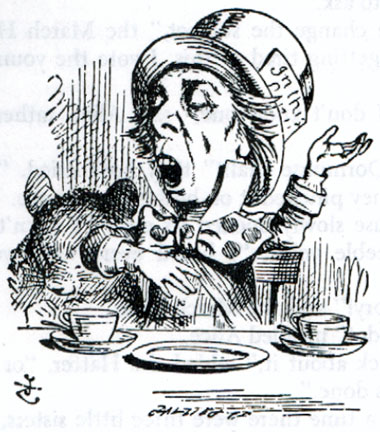
The Mad Hatter's Tea Party


This could have been a boring mid-term election season, but thankfully, we have the tea partiers to liven things up. Rand Paul, Sharron Angle, Sarah Palin – the fun just never stops. Tea Partiers complain that they’re fed up, and they’re a legitimate political movement, but it’s difficult to take them seriously when they appear to be channeling the Mad Hatter.

Take Rand Paul, the Tea Party candidate who won the Republican primary in Kentucky in the race to replace retiring US Senator Jim Bunning. Right after winning the primary, he was caught up in controversy over his remarks about the Civil Rights Act and the Americans With Disabilities Act. He said that he’s in favor of ending discrimination, but opposed to telling business owners that they can’t discriminate, and that’s pretty much what he said about the ADA. Not only did he say this stuff, he went on television to justify it. That didn’t go well for him. Apparently the GOP hasn’t been able to reel him in, because he steps in it every time he opens his mouth. After the Deepwater Horizon explosion, where 11 people were killed, and millions of gallons of oil drained into the ocean, Mr. Paul’s sympathies were with BP. He told Good Morning America that “accidents happen” and that President Obama was “un-American in his criticism of business.”

Shortly after that, the disavowals began. Mark Meckler of the Tea Party Patriots said of Rand Paul, “He’s a politician. HE doesn’t represent the movement on anything regardless of what he says.”

Since then, Rand Paul has gone on to further distinguish himself with his knowledge of coal mining in Kentucky. At a campaign stop at the Harlan Center, Paul was asked about the disaster at the Big Branch Mine, where 29 miners were killed. Paul said,” "Is there a certain amount of accidents and unfortunate things that do happen, no matter what the regulations are?" Paul says at the Harlan Center, in response to a question about the Big Branch disaster. "The bottom line is I'm not an expert, so don't give me the power in Washington to be making rules. You live here, and you have to work in the mines. You'd try to make good rules to protect your people here. If you don't, I'm thinking that no one will apply for those jobs.” It’s a charmingly naive Libertarian viewpoint, to think that no one will apply for jobs in a dangerous setting, but it’s not based in any kind of reality. The mine had been cited for over 1300 safety violations over a 5-year period. Sometimes an accident is not an accident. This Randian philosophy hasn’t endeared him to coal miners, who rely on safety regulations to protect them. Paul also believes that business should be self-regulating, a tired bit of baloney that is continually recycled by people who work behind desks.

Another Tea Partier running for the US Senate is Sharron Angle of Nevada. Last week, I mistakenly gave her credit for the plan to barter health care for chickens. That was Sue Lowden, who was apparently so crazy that Sharron Angle defeated her in the primary. Angle’s been in the news this week, because a reporter unearthed an interview where she discussed her belief that the agenda of the Democrats are a “violation of the first commandment.” Not amendment. Commandment. Angle is in favor of a theocracy, and in her view, social programs being pushed by Democrats are turning our government into God. Apparently Ms. Angle’s Bible is uncluttered with all that stuff about compassion, and caring for the poor and needy. Angle is opposed to abortion even in the case of rape or incest. She advocates that young women pregnant by rape or incest should “turn lemons into lemonade” by having the baby. One wonders if she would counsel a family member in the same way – and one is certain that Ms. Angle has never been raped. She wants to make Nevada the spent nuclear fuel capital, by promoting the waste dump at Yucca Mountain. Angle also called the escrow fund for victims of the oil spill set up by BP “a slush fund.” She backtracked on that pretty quickly, though; later saying it was “an important first step.” In any case, a Republican with a pulse and a flag lapel pin should be able to beat Harry Reid in this election – but Tea Party Sharron is apparently too crazy for Nevada.

Meanwhile, back home in New Hampshire, the Tea Party is hard at work. Tea Partiers claim to be opposed to government interference, but it’s hard to see any sign of that at the NH Tea Party Coalition website. They’re opposed to marriage equality – which means they support government interference in our private lives. They’re opposed to abortion, which means they support government interference in women’s lives. They claim that schools are for brainwashing children, which does make a certain amount of sense. People who lack literacy and critical thinking skills would be far more likely to blindly follow these Tea Partiers. There’s plenty of talk about “socialism” a term always erroneously used by teabaggers and Republicans. They support the Arizona immigration laws, but they aren’t racists.

Of course not. Tea Partiers claim to be defenders of the Constitution, and angry about runaway government spending. It’s surely a coincidence that they ignored the Patriot Act and the decadent spending of the Bush administration – and chose to form up during the administration of our first black president. Are we the Dormouse, or are they?


“Up above the world you fly,
Like a tea tray in the sky.
Twinkle, twinkle, little bat!
How I wonder what you're at!”


The Mad Hatter, in Lewis Carroll’s Alice in Wonderland


published as an op-ed in the August 6, 2010 edition of the Conway Daily Sun
© sbruce 2010

Job insecurity and Stagnant Wages

Financial Insecurity in the USA

Insecurity in America is on the rise—and was even before the Great Recession.

The Rockefeller Foundation just released a study of economic insecurity in America, which was developed by Yale professor Jacob Hacker and measures harsh changes in circumstance: For example, it reveals how many Americans have been subjected to a staggering decline of 25 percent of "available household income," either from loss of income or sudden, unanticipated out-of-pocket medical costs, and how many were without the savings to buffer the damage. Brutal losses such as these take six to eight years to recover from, the report said.


A 25% decline in household income? Surely this can't be common.

Economic insecurity affected 12.2 percent of Americans in 1985 and spiked to 17 percent during the 2000 downturn. In 2007, when economists were celebrating "the Great Moderation," insecurity was higher than in 1985, affecting 13.7 percent of Americans. In 2009, after the downturn, Hacker estimates that one in five Americans was hit with a 25 percent decline in available household income. And the report estimates that between 1996 and 2006—before the collapse—fully 60 percent experienced such loss.

One in five families in 2009? That's pretty common.

But Ben Bernacke says:

Federal Reserve Chairman Ben S. Bernanke said rising wages would probably spur household spending in the next few quarters, even as weak job gains dragged down consumer confidence.

He never tells us where these rising wages will come from. Wall St. would be my guess.

On Main St. workers are actually being subjected to pay cuts:

The furloughs that popped up during the recession are being replaced by a highly unusual tactic: actual cuts in pay.

Local and state governments, as well as some companies, are squeezing their employees to work the same amount for less money in cost-saving measures that are often described as a last-ditch effort to avoid layoffs.


Let's be clear. These are not pay freezes - these are actual pay cuts.

It is impossible to say how many employers have cut workers’ pay, because the government does not keep such statistics. Economists say a modest but growing number of employers have ordered wage cuts, especially in the public sector. In a 2010 survey by the National League of Cities, 51 percent of the cities that responded said they had either cut or frozen salaries of city employees, 22 percent said they had revised union contracts to reduce some pay and benefits, and 19 percent said they had instituted furloughs.

Some businesses are also cutting workers’ pay, often to help stay afloat or to eliminate their losses, although a few have seized on the slack labor market and workers’ weak bargaining power to cut pay and thereby increase their profits and competitiveness.


Right now workers will agree to almost anything to stay employed and some businesses are willing to hold workers hostage by threatening their jobs.

At a time when the official unemployment rate is nearly 10%, it's shocking to learn that USAID (US Agency for International Development) is contributing to train offshore IT workers:

Despite President Obama's pledge to retain more hi-tech jobs in the U.S., a federal agency run by a hand-picked Obama appointee has launched a $36 million program to train workers, including 3,000 specialists in IT and related functions, in South Asia.

Following their training, the tech workers will be placed with outsourcing vendors in the region that provide offshore IT and business services to American companies looking to take advantage of the Asian subcontinent's low labor costs.

Roger Smith spoke with the CEO of Engine Yard, Lance Walley, about their Ruby and Rails deployment platform.
Under director Rajiv Shah, the United States Agency for International Development will partner with private outsourcers in Sri Lanka to teach workers there advanced IT skills like Enterprise Java (Java EE) programming, as well as skills in business process outsourcing and call center support. USAID will also help the trainees brush up on their English language proficiency.

USAID is contributing about $10 million to the effort, while its private partners are investing roughly $26 million.


This is one unholy partnership. USAID is working with US companies (using some of our tax dollars) to help them avoid paying US labor costs by training overseas workers to get jobs, at a time when so many Americans are out of work.

The mind boggles.


Originally posted at MainSt/workingamerica.org

Tuesday, August 03, 2010

Robbing the Poor Instead of Cutting Corporate Welfare

States are begging for federal aid. And this week, the Senate is voting on an aid package that would give states Medicaid dollars, as well as money to keep teachers on the payroll. There is a catch. The money for this aid will be taken from SNAP, the Supplemental Nutrition Assistance Program - formerly known as food stamps.

That's right. To pass this aid package, the Senate is willing to take food away from children and families:

But to gain the votes of the Republicans necessary for passage, the bill includes “pay fors” to make it deficit-neutral. There is language to close a foreign tax credit loophole, raising $9 billion. Billions more come from tinkering with Medicaid drug prices and rescinding unspent funds from a variety of programs. But controversially, the bill will also likely slash $6.7 billion from the Supplemental Nutrition Assistance Program, or SNAP, the benefits formerly known as food stamps. This might result in a cut in benefit checks from one month to the next — an unprecedented event in the history of the benefit.

American food stamps are not generous, averaging only $4.50 a day even after being bumped up in the recession-era stimulus — less than you’d need to buy two meals at McDonald’s. And since the start of the recession, the number of families depending on them has skyrocketed. The economic crisis has pushed 12.9 million people into SNAP; as of April, more than 40 million collect the bare-bones benefits. More than 6 million Americans report no income whatsoever except for SNAP — because they are not eligible for unemployment insurance, Social Security, disability or other programs.

and:
Still, the suggestion caused outrage on the Hill. The House Appropriations Committee originated the education-jobs provision in a war supplemental bill, and in an interview with the Fiscal Times, its chair, Rep. Dave Obey (D-Wis.), first revealed that the White House had suggested cutting SNAP early in the summer.

“We were told we have to offset every damn dime of [new teacher spending]. Well, it ain’t easy to find offsets, and with all due respect to the administration their first suggestion for offsets was to cut food stamps. Now they were careful not to make an official budget request, because they didn’t want to take the political heat for it, but that was the first trial balloon they sent down here,” he said.


It ain't easy to find offsets? He's joking, right?

But this is also a question of priorities, of what gets cut. Bernie Sanders put up an amendment last month to cut about $35 billion in oil and gas subsidies. It failed. Republicans are arguing to extend Bush's tax cuts for the rich with no offsets, and they may well succeed. But food assistance for poor families? You can get the votes to slash those.


How can this be? Sadly, it all comes down to money and influence:

The oil and gas industry, of which BP is a member, reported $169 million in 2009 lobbying expenditures.


Poor people spent $0 on lobbying.


Originally posted at Main St/workingamerica.org